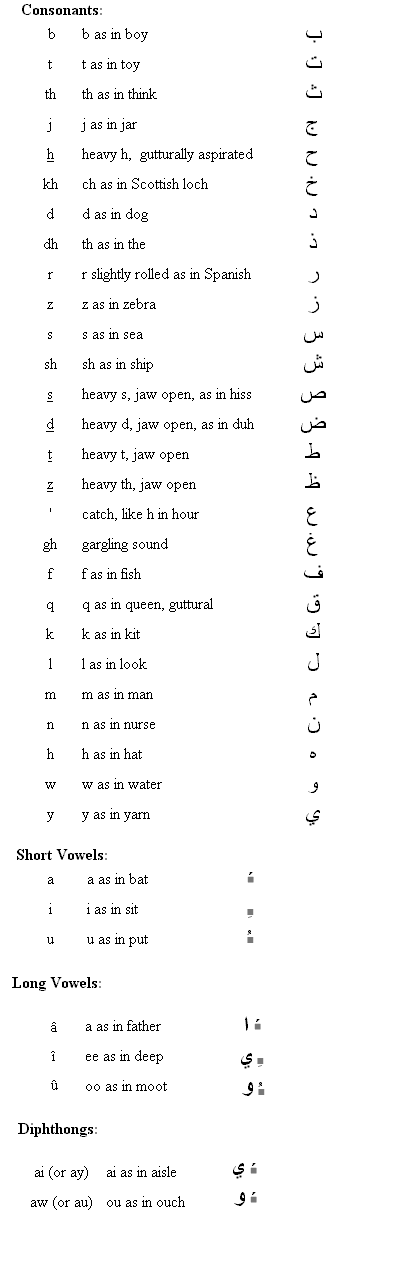
|
updated 9-Dec-2025
|
|
ab - Farsi آب āb: water, river; sparkle, luster, elegance; dignity. (in some texts as aab) (fjs1, jtp1) ab-i hayat - Farsi/Arabic اب حیاة āb-i ḥayāt: water of life, immortality, fountain of life, spiritual discourse, inspired knowledge. (fjs1,jtp1) Abul Ala - Arabic: Syrian-born poet and philosopher Abū al-'Alā Ma'ārī (927-1057). acharya - Sanskrit आचार्य ācārya: 'knowing the rules', spiritual guide; a title suffixed to the name of a learned person, such as Shankaracharya. (mw131) adhikar - Sanskrit अधिकार adhi-kāra: authority, privilege, right. (mw20) advaita - Sanskrit अद्वैत advaita: 'no duality', without duality; sole, unique; oneness of spirit and matter, oneness of the supreme soul (paramātman) with the human soul (jivātman). The philosophy that everything is God, that there is nothing other than God. (mw19) The aim of all religions and philosophies
is the understanding and the realization of unity. The Vedanta philosophy
teaches advaita: there is no such thing as 'two';
the whole is one and the same being. In the Bible it is said, 'I
and my Father are one,' which means unity...
ahriman - Farsi اهرمن ahriman: seducer, demon, devil; the principle of evil; that which is opposed to the principle of good. (fjs124) Ahura Mazda - Avestan (ancient Persian) ahura-mazda: ' Lord Wisdom', Wise Lord. The supreme God in the ancient Persian monotheistic religious system taught by Zoroaster (Zarathushtra) sometime around 1000 BC. Ahura Mazda is said to be the beginning and the end, the creator of everything which can and cannot be seen, the Eternal, the Pure and the only Truth. Also referred to as Ormuzd. (see also ahriman) (the Farsi term yazdān also refers to God) akasha - Sanskrit आकाश ākāśa: free or open space, openness; sky, atmosphere. Esoterically referred to as 'accommodation' or 'capacity' (a place for something to exist), and the word 'scope' is often used to describe the vast opportunity provided by the akasha. (mw126) To make a place is to make
an Akasha ... When you make yourself an Akasha for God to be enshrined
in, that is the only purpose for which this body was made. It was
made that God might take charge of it, might be awakened in this
body. By doing this one fulfills that purpose, one opens this place
for God, one makes it the places for God, and says, 'Now You
be enshrined in this place; it belongs to You, You made it.'
The word capacity refers to
the unconfined basis for experience, as in the moment just before
something takes place. ... The analogy for this is a bright mirror,
a readiness for experience to unfold without any preconception whatsoever. akbar - Arabic ﺍﻛﺒﺮ akbar: greater, greatest in estimation, rank or dignity; older, senior-ranking. (see also Allahu Akbar) Also, Akbar was a great Mogul emperor of India (1542-1605 AD). From the Arabic root k-b-r meaning to be great, large, famous; to gain in significance, become important; to exceed in age, be older; to become too great, burdensome. (hw948, ao476, ewl2587) akhlaq - Arabic ﺍﺧﻼﻖ akhlāq (plural of khulq): manners, disposition; morals, ethics, virtues. (hw299, fjs26, jtp30) akhlaq-i Allah - Arabic/Farsi Akhlāq-i Allāh means the manner of God, or Divine Manner. aladdin, alauddin - Arabic علاء الدين alā'-ud-din : nobility of faith. alā' = noble, high standing, high ranking; u = genitive suffix, often translated as of; din = faith, religion, duty (also written as alaoddin, alauddin) (hw749) al-hamdulillah - Arabic al-ḥamdulillāh: Common translations include: All praise is for Allāh, All praise is to Allāh. This phrase is made of five parts: al = the; ḥamd = praise, commendation, or extolling the virtues of; u = genitive suffix denoting that the previous word (hamd) is the subject of the phrase; li = to, for, unto, on account of; and llāh = Allāh. (also see the Arabic Devotional Terms web page for more phrases) (hw238, jtp481) al-kimia - Arabic al-kīmiyā': chemistry; alchemy; the philosopher's stone. (possibly from Greek xhmia) (hw997, fjs1070, jtp890) alam-i mithal - Arabic 'ālam-i mithāl: the world of visions, world of dreams, world of ideals. (fjs1172) Allah - Arabic ﷲ allāh: the Arabic proper name for the Supreme Deity. The exact derivation of this word is unclear, but it is likely related to the Aramaic Alaha and to the ancient Hebrew El. (hw30) Note: For those who may be uncomfortable with the word Allah, it may be helpful to note that in the Semitic language of Aramaic which Jesus most likely spoke, the Aramaic word which is translated as God in the European bible was actually Alaha. According to some linguists, the word Alaha which Jesus spoke would have had the ending "a" softened or not pronounced at all, leading to the pronunciation "alah". Since the Arabic language was largely derived from the earlier Aramaic (much the same as Aramaic was derived from the earlier Hebrew), the modern Arabic word Allah is likely derived from the earlier Aramaic pronunciation "alah". Indeed, Allah of the Qur'an and Alaha of Jesus refer to the same One. In contrast, the word "God" is a relatively new, and perhaps unfortunate, European invention which has been the source of much misunderstanding and conflict.
Allahumma - Arabic اللَّهُمَّ allāhumma: O' Allah (often used rather than yā Allāh). (hw30) Allahu akbar - Arabic allāhu akbar: Commonly translated as: Allāh is Greater, Allāh is Great, or Allāh is Most Great. This phrase is made of three parts: Allāh = the Supreme Deity; u = a suffix denoting that Allāh is the subject of the phrase; and akbar = greater, greatest in estimation, rank or dignity; older, senior-ranking. This phrase is called Takbīr. (hw948, ao476, ewl2587) ammara - Arabic امارة ammāra (feminine of ammār): commanding, ordering, domineering, headstrong. This term is often used to describe the carnal, sensuous aspect of the nafs. (used in the Qur'an 12:53) (fjs97, jtp79, hw34) amin - Arabic آمين āmīn: in this we trust, in this we have faith; amen; be it so. From the Arabic root a-m-n meaning to be faithful, reliable, trustworthy; to reassure, safeguard, guarantee. (hw36, ao34) amr - Arabic امر amr: command, order, decree; power, authority; affair, concern, transaction; event, occurrence, act; fact, circumstance. The phrase Amr-i Allah could be translated as command of Allah, or act of Allah. (hw33, fjs99, jtp81) anfas - Arabic انفاس anfās (plural of nafas): breaths, respirations; voices, words. (hw1156, jtp93) anvar - Arabic انوار anwār (plural of nūr), Farsi anvār : lights, gleamings, rays of light. (hw1183, fjs116, jtp99) anzar - Arabic انظار anẓār (plural of naẓar): visions, sightings; glances; perceptions, insights. (hw1144, fjs111) apsara - Sanskrit अप्सरस् apsaras or apsarā: 'between the waters and the clouds', a class of female divinities who inhabit the sky, heavenly nymphs, fond of water, the wives of the Gandharvas. They change their shape at will, and are said to dance (and/or sing) for Indra. (in some texts as Upsara) (mw59) aqibat - Arabic ءاقبة 'āqibah, Farsi 'āqibat: end, termination, conclusion, outcome, consequence; coming after, recompense, reward, future life. (hw733, fjs830, jtp757) arsh - Arabic عرش 'arsh: throne, throne of God; a place of abiding; palace, citadel; buttress, support. (hw704, fjs842) artha - Hindi/Sanskrit अर्थ artha: advantage, profit, benefit, use, utility; concern, business, affair, matter; substance, property, wealth, opulence; worldly prosperity. (incorrectly spelled ardh in some papers) (mw90, mcm27, jtp39) ashiq - Arabic عاشق 'āshiq ( from the root 'ishq): lover, fancier, fan, sweet-heart; one filled with divine love. (hw719, fjs830) ashraf - Arabic اشراف ashrāf (plural of sharīf): distinguished, eminent, noble, high-bred, honorable, honest. (hw545) asman - Farsi آسمان āsmān: heaven; sky, the celestial orb, the canopy of heaven. In esoteric terms, this is often used much the same as the Sanskrit akasha, to describe capacity or accommodation (see akasha). (fjs60, jtp53) asrar - Arabic اسر asrār (plural of sirr): secrets, mysteries, something concealed; secret thoughts, innermost thoughts, or, as E. W. Lane variously put it: private knowledge; something inserted in the interior; a pleasure, or delight, and dilation of the heart, of which there is no external sign. (hw471, fjs57, ewl1337) asrar ul-anasir - Arabic اسرار العناصر asrār ul-'anāṣir: from asrār (plural of sirr) meaning secrets, mysteries, u indicating that asrār is the subject of the phrase, al meaning the, 'anāṣir (plural of 'unṣur) meaning elements, constituents: secrets of the elements. (hw471,760, fjs57, 868) asura - Sanskrit आसुर asura: spiritual, divine; supreme spirit; evil spirit, demon. (mw121, rsm69) asvara - Sanskrit अस्वर asvara: not loud, indistinct; in a low tone. (in some texts as Asura) (mw124) atish - Farsi آتش ātish: fire, light; fire of love, passion; splendor (in some texts as atesh) (fjs13, jtp16) atman, atma - Sanskrit आत्मन् ātman: singular masculine ātmā: the breath; essence, nature, character; understanding, intellect; the soul, individual soul; the highest personal principle of existence. Prefixes are often used to help clarify the meaning, such as jīvātman (living, personal soul), mahātman (great soul), paramātman (supreme spirit). (hw135) In the Vedanta the soul is
called by three names which denote its three aspects, Atma, Mahatma,
Paramatma. Atma is the soul conscious of the life on the surface,
Mahatma is the soul conscious as well of the life within, Paramatma
is the consciousness that is the soul of souls, conscious of the
Absolute within and without, the God of the knower, the Lord of
the seer. Avicenna - Avicenna: a Latinized version of the name ibn Sīnā (980-1037 AD), a great Persian mystic, physician, philosopher and scientist. Avicenna, the great physician
of ancient times, on whose discoveries medieval science was based,
was a Sufi who used to sit in meditation, and by intuition he used
to write prescriptions. avatar - Sanskrit अवतार avatāra: incarnation, appearance of a deity on earth, any new unexpected appearance; descent, descent of a higher consciousness, descent of a deity from heaven. (mw99, jtp102) avidya - Sanskrit अविद्य a-vidyā: 'not-knowing', ignorance, false understanding, spiritual ignorance. (mw108, rsm64) azam - Arabic ﺍﻋﻈﻢ a'ẓam: greater, bigger, paramount, supreme, most important. (see also ism-i azam) (hw729, fjs75, jtp60) bad - Farsi باد bād (from Sanskrit vāta) : air, wind, breeze; breath, name of an angel presiding over the winds. (in some texts as baad) (fjs137, jtp118) bad - Farsi بد bad: naughty, bad; wicked, evil. (fjs160, jtp138) banda - Farsi بنده banda (from Sanskrit bandha): bound, fastened, restrained; servant, slave. (fjs202, jtp170) bandagi - Farsi bandagī: slavery, bondage, servitude; service; devotion, adoration, worship, praise; compliment, salutation; humility, lowliness; or, as an intj. My service to you! good-bye! thank you! (fjs202, jtp169) baqa - Arabic بقاء baqā': remaining, staying, lingering, abiding; continuation of existence; immortality, permanence. (hw84) The ideal perfection, called
Baqa by Sufis, is termed 'Najat' in Islam, 'Nirvana'
in Buddhism, 'Salvation' in Christianity, and 'Mukhti'
in Hinduism. This is the highest condition attainable, and all ancient
prophets and sages experienced it, and taught it to the world.
baqi bi-Allah - Arabic bāqī bi allāh: bāqī = everlasting, eternal, immortal; bi= by means of, through, from; pemanence from Allah, eternal existence in Allah. (ao60) basarat - Arabic بصارة baṣāra, Farsi baṣārat: perception, discernment. (hw75, fjs190) basir - Arabic بصير baṣīr: seeing, having eyesight; discerning, knowledgeable; having insight; acutely aware. The name al-Basir refers to Allah as the All-Knowing, All-Seeing, All-Perceiving. (also see baṣīr in 99 Names of Allah) (hw75) bast - Arabic basṭ: spreading, extending, expanding, unfolding. (the opposite of kabs) (hw72) batin - Arabic bāṭin: inner, interior; secret, hidden, concealed. (Bāṭin is pronounced baatin, while a similar word baṭīn, pronounced bateen, means fat, corpulent, gluttonous.... quite a difference!) (also see bātin in 99 Names of Allah) (hw79) ba-yaki - Farsi ba-yakī: ba=with, by, through, yaki=oneness, unity. (fjs135, 1535) bayat - Arabic bai'at: profession of loyalty, oath of allegiance; initiation as a disciple of a religious guide. (hw105, jtp210) Devotion requires an ideal,
and the ideal of the Sufis is the God-ideal. They attain to this
ideal by a gradual process. They first take bayat, initiation, from
the hand of one whose presence gives them confidence that he will
be a worthy counselor in life and a guide on the path as yet untrodden... Bayazid - Bayazid: Bayazid Bastami (777-874 AD) Sufi saint and mystic from Bastam in eastern Persia (Iran). A prayer from Bayazid: Oh, Allah, how long will this 'you'
and 'I' remain between You and I, baz - Arabic bāz: hawk, falcon, eagle. In esoteric terms, one who soars above, a wayfarer of the heavens. (hw100, fjs144, jtp121) Bhagavad-Gita - Sanskrit
bhakti - Sanskrit
bhandara - Hindi भण्डारा bhanḍārā: a meal for the holy ones; a feast of the sanyāsīs. (jtp192, rsm755) bhavasagara - Sanskrit
bi-charagi - Farsi بیچارگی bī-chāragī; bī = without, chāra = remedy; helplessness, inability, incapacity (in some texts as vecharagi, becharagi, becharegi) (fjs216) bismillah - Arabic bismillāh: Commonly translated as: In the name of Allah. A phrase made of the following: bi = with, to for, in, through; ism = a distinguishing mark, name, light, vibration, essence; llāh = Allāh. (also see the bismillah web page for more insights) bodhi - Sanskrit
bodhisattva - Sanskrit
Brahma - Sanskrit
Brahmachari - Sanskrit brahma-cari: student of sacred study; one who observes the vows of sense-control; the first of the four stages of spiritual life. Brahman - Sanskrit
brahmin - Sanskrit
buddhi - Hindi
buddha - Sanskrit
Bullah Shah - Abdullah Shah (1680-1758 AD) Sufi poet and Qawwali, born near Bahawalpur, Pakistan. His message was one of truth, love and compassion. His guide was Hazrat Shah Inayat, a well-known Qadiri Sufi and gardener by profession. Bullah asked his guide, "I wish to know how to realize God." Inayat Shah replied, "What is the problem in finding God? One only needs to be uprooted from here and replanted there." The tomb of Bullah Shah is in Qasur, Pakistan. (often written as Bulleh Shah) You alone exist; I do not,
O Beloved! buraq - Arabic burāq: the donkey-like creature upon which Muḥammad is said to have ascended one night from Jerusalem to heaven and then returned to Mecca. (see also miraj) (hw67, fjs168, jtp144) buzurg - Farsi buzurg: great, venerable, noble; elder, aged; wise man, holy man, saint, sage. (jtp153)
chaitanya - Sanskrit
chakra - Sanskrit
chela - Hindi
cherag - Farsi
The work of a cherag is to help a person
to live... Chishti - The Chishti Sufi Order was founded (c 900 AD) in the city of Chisht (a small town near Herat, Afghanistan) by Abu Ishaq Shami whose teacher sent him from Syria to spread the Sufi message. The Chishti Order is one of the oldest Sufi orders currently existing, and often makes great use of sound and music in its practices. After receiving instruction in the five different
grades of Sufism, the physical, intellectual, mental, moral, and
spiritual, I went through a course of training in the four schools:
the Chishti, Naqshibandi, Qadiri, and Suhrawardi. I still recall
this period, under the guidance of so great and merciful a Murshid,
as the most beautiful time of my life. dakhl dar maqulat - Farsi/Urdu dakhl dar ma'qūlāt: 'intrusion into intellectual matters', interference, interruption. (in some texts as dakhl dar makulat) (jtp507) darood - see durood daya - Sanskrit
dervish - Farsi درويش darvesh: poor, indigent, beggar, religious mendicant. (in some texts as darwish) (fjs516, jtp514) deva - Sanskrit
dharma - Sanskrit
In Sanskrit religion is called
Dharma, which literally means duty. To give a definition
of what religion is one can say that it is an unswerving progress
towards the ideal. The divine life has a certain
capability to give life, and it gives this life as teaching to the
children of earth, and this teaching is called
Dharma, religion. Religions
are many and different from one another, but only in form, for water
is one and the same element, and formless, only it takes the shape
of the channel which holds it and which it uses for its accommodation;
and so the name water is changed into river, lake, sea, stream,
pond, etc. So it is with religion; the essential truth is one. When man has risen to the
stage of development where he can be the perfect instrument of God,
when nothing of his own being stands in the way of the direct impulse
that comes from within -- that spirit may be called perfect. That
which is most precious, that which is the purpose of man's life
is to arrive at that state of perfection when he can be the perfect
instrument of God. dhikr - please see zikr (hw358) dholak - Hindi ढोलक ḍholak: a small drum. (jtp573, rsm430) dil - Farsi ﺩﻞ dil: heart, soul; mind; valor; the center. (see also qalbi) (fjs530, jtp522) din (deen) - Arabic ﺩﻳﻦ dīn: creed, belief, religion. It is said that there is only one dīn; that which is the natural, intended, proper manner of life, acting in harmony with the will of the Creator and thereby in harmony with all of creation. The classical Arabic root d-y-n signifies that which is obedient, abased, submissive; doing service for; acting well towards; and also signifies receiving a loan, being indebted, repaying a debt. Thus dīn signifies repaying our debt to our Creator through humble submission and loving service. To do so, it is a common Sufi practice to strive to be like a perfect mirror, reflecting all of the magnificence and glory back to the Beloved and into this world, illuminating any darkness. Hazrat 'Ali said 'The love of the wise is a religion (dīn) with which Allah is served.' (Note that Arabic dīn is essentially identical in meaning to the Sanskrit dharma) (hw353, jtp558, ewl942) dipak - Sanskrit दीपक dīpaka: kindling, inflaming; illuminating, lighting. (mw481) dua - Arabic ﺩﻋﺎء du'ā': prayer, request, plea; supplication (to God); an invocation of good, a blessing, benediction; wish; congratulation, salutation. (in some texts as do'a) (hw327, fjs527, jtp518) dunya - Arabic ﺩﻨﻳﺎ dunyā: literally 'nearest', the present world, the present life or state of existence; the people of this world, people; a whole world, a multitude; worldly enjoyments, temporal possessions. (hw340, fjs539, jtp529) durood - Farsi درود durūd: benediction, blessing, mercy; prayer; praise (esp. of Muhammad); thanksgiving; congratulation; salutation. (in some texts as darood or darud) (fjs515, jtp514) dvija - Sanskrit
etekad - Arabic اعتقاد i'tiqād: trust, dependence, faith, confidence, belief. (verbal noun from root '-q-d: to put together, join) (hw735, fjs73) fana - Arabic ﻓﻨاء fanā': passing away, cessation; destruction, annihilation; vanishing, extinction; nonexistence; obliteration of the self (ego). (hw854, ewl2451, fjs939) fana-fi-Shaikh, fana-fi-Rasul, fana-fi-Allah - Arabic: fanā'= passing away, cessation; destruction, annihilation; fī = in, into, among, together with.
faqir - Arabic فقير faqīr: poor, needy; beggar; ascetic, dervish, itinerant monk, one living on whatever is given. (in some texts as Fakir) (hw846, fjs935) fazl - Arabic فضل faẓl, v.n.: remaining over and above, exceeding, being redundant; excelling; excess; a remnant, remainder; excellence, virtue, accomplishment; learning, wisdom, science; a gift, present, favor, grace, bounty. Inayat Khan described fazl as "the word of illumination". From the Arabic root f-ẓ-l meaning to have a remainder, have over-abundance; to exceed, surpass; to be excellent, superior, exquisite; to ascend beyond. (hw840, fjs932, jtp782, ewl2411) fikr - Arabic فکر fikr: thinking, cognition, reflection, meditation, contemplation. Inayat Kan used this term to describe silent repetition, such as a wazifa. (in contrast to zikr, which he used to describe spoken repetition) (hw848) firishta - Farsi فرشته firishta: an angel, a messenger, an apostle. The phrase Firishta Khaslat means angelic character. (in some texts as Farishta) (fjs919) Firdausi - Persian poet Abu al Kasim Mansur used the pen name Firdausī (934-1020). After Persia had been under Arab control for many years, Sultan Mahmud of Ghazna was concerned that the Persian history would be lost, so he commissioned Firdausī to write the 60,000 verse epic poem Shāh nāma (Book of Kings) recording the deeds of legendary Persian kings and heroes, which is considered to be the first modern Persian literature. (Also written as Firdawsi or Firdousi) gandharva - Sanskrit
Ganga - Sanskrit
gardish - Farsi کردش gardish: turning round, revolving, conversion, motion; turn, change; a bend; vicissitude; reversion; adverse fortune; wandering about, vagrancy. (fjs1080, jtp903) garm - Farsi garm: hot, glowing, burning; ardent, zealous, excited, active, lively. (fjs1084, jtp904) gatha - Sanskrit
Gautama - Siddhārtha Gautama, known as Buddha. Siddhārtha's mother died shortly after his birth, and her younger sister, Gautami, raised the young prince, who was then called Siddhārtha Gautama. (see Buddha) gayan - Sanskrit
gayatri - Sanskrit
ghaib - Arabic ghaib: hidden, unseen, concealed, invisible. (in some texts as ghayb) (hw806) ghairat - Arabic غيرة ghaira, Farsi ghairat: jealousy, to guard jealously; care of what is sacred or inviolable; a sense of honor; courage. (hw807, fjs901, jtp774) Ghalib - Arabic ghālib: dominant, overpowering; triumphant, victorious. Famous poet Mizra Asadullah Beg Khan Ghalib (1797-1869 AD) who wrote in Urdu and Farsi, a master of the ghazal form, court poet for Bahadur Shah Zafar. (hw796, fjs879) ghar-i hira - Arabic ghār-i ḥirā': literally 'cave of inquiry'. The name of the mountain cave northeast of Mecca where the angel Gabriel first began to recite the Qur'ān to Muḥammad. From ghār meaning cave, cavern, den; and ḥirā' meaning seeking, inquiry, investigation. (in some texts as Gar-i Hira) (hw804 and 202, jtp768, fjs414) There is a still greater and
deeper experience: when a person is in a wilderness, near rocks
in the desert, where there is no sound even of birds or beasts,
when there is absolute silence. In the East, did not all the prophets
from the time of Abraham, Moses, David, and in the time of Christ
and Muhammad, all the prophets of the Old Testament and the New,
and of the Qur'an, receive their inspiration from the same source?
The history of Moses on Mount Sinai, the Prophet of Nazareth in
the wilderness, the Prophet Muhammad on Ghar-i Hira, did they not
all drink from the silent life? ghaus - Arabic غوث ghauth, Farsi/Urdu ghaus: call for help; helper; one who aids, delivers from difficulty, removes trouble or affliction. (in some texts as ghous) (hw804, ewl2306) Ghazali - Arabic غزال ghazāl: gazelle; rising sun; the name of a Persian village in Tūs (where al-Ghazālī was born). Persian mystic, writer, jurist, theologian Abu Ḥamīd Muḥammad ibn Muḥammad al-Ghazālī (1058 - 1111 AD). (sometimes written al-Ghazzali) (hw788, fjs887) ghilman - Arabic غلمان ghilmān (plural of ghulām): servants, pages, waiters; lads, youths. (hw798, fjs893) ghiza - Arabic ﻏﺬﺎﺀ ghidha': Farsi/Urdu ghiza: food, diet, provision, victuals; aliment, nutriment. (hw781, fjs882, jtp769) Music is called Ghiza-i-ruh,
the food of the soul, by Sufis. Music being the most divine art
elevates the soul to the higher spirit; music itself being unseen
soon reaches the unseen; just as only the diamond can break the
diamond, so musical vibrations are used to make the physical and
mental vibrations inactive, in order that the Sufi may be elevated
to the spiritual spheres. gita - Sanskrit
githa - Sanskrit
gopi - Sanskrit
grihasta - Sanskrit
guna - Sanskrit
gunbad - Farsi gunbad, gunbaz: arch, vault, cupola, dome, tower; an arched gateway; a triumphal arch; bud of a flower; a cup. (in some texts as gunbad) (fjs1098, jtp916) guru - Sanskrit
habib - Arabic حبيب habīb: friend; beloved, sweetheart, lover; darling; dear one. From the Arabic root ḥ-b-b meaning to evoke love or liking; to endear; to make lovable, dear, attractive; to show affection. (hw179) Note: The phrase "habībī Allāh" could
be translated as "my beloved Allāh", while the phrase "habīb
allāh" or "habībullāh" could be translated as "beloved
of Allāh" or "loved by Allāh". Hafiz - Arabic حافظ ḥāfiẓ: keeper, guardian, preserver, caretaker. The great Sufi poet, Shamsuddin Muḥammad Ḥāfiẓ, born in the early 1300's in Shiraz (Iran). (hw222, fjs408) hairat - Arabic ḥaira, Farsi hairat: amazement, astonishment; bewilderment, confusion, perplexity; wavering (between two things). (hw258, fjs435, jtp483) hajj - Arabic حخ ḥajj: setting out, going towards, pilgrimage, the Muslim pilgrimage to Mecca. (hw184) hal - Arabic حال ḥāl: (plural aḥwāl) state, mood, attitude, circumstances, condition. Mystics often use the term ḥāl, or al-ḥāl, to refer to the state of ecstasy. From the Arabic root h-w-l meaning to change, undergo a transformation; to shift, grow, pass by. (hw252, fjs408) halal - Arabic حلال ḥalāl: being legal, a lawful thing; the opposite of haram; sanctioned by Islamic law; suitable for food, lawful to eat (hw232, fjs427, jtp480) halqa - Arabic ḥalqa: a circle, a ring, hoop; assembly of people; a fraternity. (in some texts as halka) (hw235, fjs428, jtp481) hama man am - Farsi hama man am: literally "all I am"; everything is me. The esoteric meaning is that God is all, and all is God. (in some texts as humamanarn) (fjs1512, fjs1316, fjs96) Christ said, 'I and the
Father are one'. That does not mean that Christ laid claim to
Godhood for His own person. It is what the dervishes call 'Hama
man am', which means all is He and He is all. There is not an
atom in the universe that He is not. We must recognize Him, we must
respect Him in every face, even in the face of our enemy... hamd - Arabic ḥamd: praise, commendation. (see also al-Hamdulillah above) (hw238) hamin ost - Farsi ham-īn ost: literally "even this He is" or "likewise this He is". The esoteric meaning is that God is all, and all is God. The same idea is also commonly written as hama ost, meaning everything is He, each is He, or all is He. (in some texts as naminaust) (also see hama man am ) (fjs1507, fjs132, fjs120, jtp1236) hamsa - Sanskrit
haqiqat - Arabic ḥaqīqat: (plural ḥaqā'iq) true state of affairs, true nature, essential quality, essence; spiritual truth (which is unchangeable and unchanging). (also see Marifat) (hw224, fjs426) haqq - Arabic
haram - Arabic ḥarām: unlawful, forbidden, prohibited; wrong-doing; illegitimate. (hw210, fjs414) Hashimi Arabic هاشم hāshim: one who breaks bread into broth; surname of an ancestor of Muhammad, on account of his breaking bread for the benefit of the poor at the time of a great famine. Sayyed Muhammad Hashimi, a Sufi mystic, was Inayat Khan's friend and academic teacher in Sufi literature. Maulana Hashimi was his great
friend and ustad, who taught him the Persian and Arabic literature
of the ancient Sufis and being a great mystic, recognized in Inayat
what other friends of his (Ramyar and Hafiz Khan) though his great
friends and admirers, were at a loss to understand. But Hashimi
knew that something was being prepared in Inayat for the years that
were in store for him, which was beyond words or imagination.
hatha - Sanskrit haṭha: force, effort; obstinacy, persistence; inevitable necessity. (pronounced hot-ha) (mw1287) hauz-ul kausar - Arabic haud-u al kauthar, Farsi/Urdu hauz-u al kausar: ocean of abundance, fountain of wine. (see also Kauthar) (in some texts as Hauzu 'l Kausar) (hw249, ao479) haya - Arabic ḥayā': modesty, bashfulness; timidity, shyness; avoiding that which is distasteful or improper. ( hw256, fjs434, jtp482) Haya
is the finest feeling in human nature, which
is called modesty.... Modesty is life itself; a life which is conscious
of its beauty yet inclined to veil it in all its forms is modesty.
At the same time modesty is the proof of sincerity and of prudence.
The immodest man cries aloud, 'I am the light' and is finished
in a moment. The diamond, shining in its light constantly, never
says a word about its light... a modest person very often will not
raise his voice, out of dignity; or say things, out of consideration
and respect. hayvanat - Arabic ḥaiwān, plural haiwānāt, Farsi hayvānāt: living, life,: brutes: animal nature, (As opposed to insānīyat which means human nature, humanness.) (hw257, fjs436) hayy - Arabic
hazrat - Arabic
hijrat - Arabic hijrat: departure, exit, emigration, separation. Hijrat Day: Inayat Khan departed from India, headed for America, on September 13, 1910. (hw1194, fjs1490, jtp1221) hosh bar dam - Farsi hosh bar dam: thinking of breath, attention upon breath. (hosh = understanding, mind, attention, thinking; bar = with, upon, into; dam = breath, vitality, life-force) (in some texts as hosh ba dam, or hosh bar dum) (fjs1518,166,534, jtp1241,143,525) hu - Arabic
This sound Hu is the beginning and the end of all sounds, be they from man, bird, beast, or thing... The Supreme Being has been called by various names in different languages, but the mystics have known him as Hu, the natural name, not man-made, the only name of the Nameless, which all nature constantly proclaims. The sound Hu is most sacred; the mystics call Ism-i Azam, the name of the Most High, for it is the origin and end of every sound as well as the background of each word. The word Hu is the spirit of all sounds and of all words, and is hidden within them all, as the spirit in the body. It does not belong to any language, but no language can help belonging to it. This alone is the true name of God, a name that no people and no religion can claim as their own.
from The Sufi Message, Volume
II, Abstract Sound hu - Sanskrit
hu - Sanskrit
hur - Arabic حور ḥūr, ḥūrīya, Farsi ḥūrī: houri, nymph, virgin of paradise. (hw247, fjs433, jtp482) ilm - Arabic 'ilm: knowledge, learning; information; perception, cognition. The Arabic root '-l-m means to know, have knowledge, be informed, be acquainted with, find out about. (hw743) ilham - Arabic ilhām: inspiration, divine revelation From the Arabic root l-h-m meaning to devour, swallow up; to inspire. (hw1033, fjs96, jtp78) Inspiration is the inner light
which reflects itself upon the heart of man; the purer the heart
is from rust, like a clean mirror, the more clearly inspiration
can be reflected in it. To receive inspirations clearly the heart
should be prepared by proper training. A heart soiled with rust
is never capable of receiving them. There are five kinds of inspiration: iman - Arabic īmān: faith, belief; sincerity and firmness of belief. From the Arabic root a-m-n meaning to be faithful, reliable, trustworthy; to reassure, safeguard, guarantee. (hw36) In an Eastern language there
is a word which is very difficult to translate: iman. It is not
exactly faith or belief; the nearest word one can find for it is
conviction, a conviction that cannot be changed by anything, a conviction
that does not come from outside. One always seeks for conviction,
one asks, 'Will anybody convince me, will this thing convince
me?' Nothing convinces, nobody convinces. Conviction is something
that comes from one's own heart and it stands above faith and
belief... imam - Arabic imām: prayer leader; model, standard, criterion; that which is followed. From the Arabic root a-m-m meaning to go, to go see, to go to a place; to follow an example. (hw32) inayat - Arabic ﻋﻨﺎﻳﺔ 'ināyat: concern, care; grace; assistance, aid; guarding, preserving; careful, painstaking, meticulous; a gift, present, favor, bounty. From the Arabic root '-n-y meaning to be concerned; feel concern; take care of, tend to, look after, to devote one's attention. (hw762, fjs869, jtp766) inkisar - Arabic inkisār: being broken, shattered, broken open; repentant. In esoteric terms: the breaking of the ego; humility, selflessness. (in some texts as enkesar or enkessar) (hw968, fjs113, jtp94) insan - Arabic insān: man, mankind, human being. From the Arabic root a-n-s meaning to be tame, companionable, friendly, sociable. (hw39, fjs110, jtp92) ishq - Arabic عشق 'ishq: love; passionate love; unconditional love that is oblivious to any shortcomings. (also written as Ishq) (in some texts as Ishk) (hw719, fjs850) ishq Allah mabud Allah - Arabic عشق ﷲ معبود ﷲ 'ishq allāh ma'būd allāh: 'ishq = unconditional love; ma'būd = beloved, worshiped, adored. Literally, Allāh is Love, Allāh is Beloved. (also written as ishq Allah mabud Allah) (hw719, hw686)
The Sufi in the East says
to himself, 'Ishq Allah, Ma'bud Allah, which means 'God
is Love, God is the Beloved', in other words it is God who is
Love, Lover, and Beloved. ism - Arabic ism: (plural asmā') name, appellation, attribute. Based on the Arabic root (variously reported to be s-m-w or a-s-m) which indicates the means by which something is distinguished, whether by use of an identifying mark, or by being raised up high so that it may be distinguished, and would include a word, name, reputation, light or vibration; all of which point toward the very essence of something, the inherent qualities and signs of the existence of something, the underlying reality of something. (hw498, fjs59, jtp52) ism-i azam - Farsi/Arabic ism-i a'ẓam: greatest name, ultimate word. (also see ism and azam) There are also words, which
no language can claim for its own. This is true of the word Ism-i
Azam, which means the word of power. No one can claim this word
as belonging to his language; it is a word, which belongs to no
language... All other words have been derived from it, for Ism-i
Azam is the spirit of all words; it is the root of all other words.
ism ur-rasm - Arabic ism u al-rasm: the philosophy of the word, the manner of the word, the doctrine of the word. (also see ism and see rasm) All down the ages the Yogis
and seers of India have worshipped the Word-God, or Sound-God, and
around that idea is centered all the mysticism of sound or utterance.
Not alone among Hindus, but among the seers of the Semitic, the
Hebraic, races the great importance of the word was recognized.
The sacred Name, the sacred Word, were always esteemed in the Jewish
religion. Also in Islam, that great religion whose mysticism the
West is only beginning to discover, one finds the doctrine of
Ism ur-rasm which translated is the 'doctrine of the mystical
word'. Islam - Arabic
اسلام islām: submission, resignation, reconciliation
(to the will of Allah). From the Arabic root s-l-m meaning to be
flawless, unimpaired, intact, sound, whole, complete; to have well-being;
success. The Arabic word salam and the Hebrew shalom have arisen
from the same ancient Semitic root. (hw497) ittifaq - Arabic اتفاق ittifāq: agreeing, consenting; concord, harmony, congruence, accord; meeting one another. (in some texts as ettefaq) (hw1272, fjs15)
Jain - Jainism is an ancient religion, deeply rooted in India, that teaches that every living thing has an eternal soul, and thus the Jains practice harmlessness to avoid harm to any living creature. The Jains believe in religious tolerance, saying that no one view can fully express reality. Jabril - Arabic jabrīl or jabra'īl: The angel Gabriel, archangel of the messengers. A compound word based on Arabic versions of the ancient Hebrew roots, variously interpreted as signifying: God is my Strength, God's Warrior, God's Might; the Arabic root j-b-r is based on the Hebrew g-b-r meaning mighty, strong, powerful, proud, warrior; and the Arabic 'īl is based on the Hebrew 'el, meaning the One God. (in some texts as Jebrail or Jibra'il) ( hw133) jafr - Arabic jafr: parchment for writing; fortunetelling, the art of divination from written characters. (hw151, fjs365, jtp382) jalal - Arabic jalāl: majesty, sublimity, splendor, glory, loftiness. (in some texts as jelal) (hw152, ao100) jam - Farsi jām: cup, chalice, goblet, drinking vessel; mirror. (fjs350) jam-i Jamshed - Farsi jām-i jamshīd: the cup of Jamshīd. The mirror-like reflecting cup of the mythical Persian king Jamshīd in which he saw the reflection of the events of the whole world, past, present or future. (Also called jām-i jamshed or simply jām-i jam) (in some texts as Yami Jamshed) (jtp372) jamal - Arabic جمال jamāl: beauty, handsomeness, grace, elegance. (The Prophet Muhammad said: Truly, God is beautiful, and God loves beauty.... inna allāha jamīlun yuḥibbu al-jamāl) (in some texts as jemal) (hw163, ao102, fjs370) jamil - Arabic جميل jamīl: beautiful, elegant, comely, pleasing; good, fair; becoming; courtesy. (The Prophet Muhammad said: Truly, God is beautiful, and God loves beauty.... inna allāha jamīlun yuḥibbu al-jamāl) (hw163, jtp390, fjs372) Jamna - Sanskrit jamnā: a river in India, also called the Yamuna. (see also sangam) japa - Sanskrit
jata nada - Sanskrit jāta-nāda: jāta means 'brought into existence by', and nāda means sound. In esoteric terms sound existed first, and sound brought light into existence; thus jāta-nāda refers to light. (also written as Jatanada) (mw417, mw534) Jilani - Farsi jīlāni: Abdul Qādir Jīlāni (1077-1166), the great Islamic scholar and mystic, born in Jīlān (Iran). The Qadiriyya Sufi order was founded upon his teachings. jinn - Arabic jinn: invisible beings, either helpful or harmful, that affect the lives of human beings. From the Arabic root j-n-n meaning to cover, hide, conceal, veil. (in some texts as djinn) (hw164) jivan - Sanskrit jivan: to be alive, to live. The phrase jivan mukta means: one who is liberated in this life: jivan = living, mukta = let loose, set free. jnana - Sanskrit
Kaba - Arabic كعبة ka'ba, ka'bah, Farsi/Urdu ka'bat: cube, cubic structure. Often used to refer to al-ka'ba, which is also called kabatullāh. The sacred al-ka'ba in Makkah (Mecca, Saudi Arabia) is a 15 meter high cubic structure made of granite, covered with black silk and gold embroidery, and around which the great Masjid al-Haram was constructed. At the time of Muḥammad, the Quraish used the al-ka'ba as a shrine to their various tribal gods. After years of conflict with the Arab tribes, Muḥammad was eventually able to dedicate al-ka'ba as an Islamic house of worship. (in some texts as Kaaba or Ka'aba) (hw973) Kabatullah - Arabic ka'bat-u-allāh: literally 'cube of Allāh'. (see kaba above)
Kabbala - Hebrew קַבָּלָה qabbala, qabbālāh: received, accepted; received doctrine, tradition; mystical teachings of rabbinical origin, often based on an esoteric interpretation of the Hebrew Scriptures, largely developed after the 7th century AD. (also written as Kabala, Kabbalah, Qabala, Qabalah, Caballah) kabs - Arabic kabs: pressure, pressing, squeezing, compressing. (the opposite of bast) (hw949) kafi - Arabic kāfin, kafīy; Farsi kāfī: sufficient, enough; suitable, fit; capable, able, qualified; adequate, all that is needed. (see also Additional Wazaif) (jtp802, hw977) kafir - Arabic كافر kāfir: irreligious, unbelieving, atheist; ungrateful. (hw975) kalgi - Farsi/Hindi kalgī; an ornament attached to a turban, plume, crest, jewel; comb (of a cock) (in some texts as kalaggai, kalagai) (fjs1043, rsm177) kala - Sanskrit काल kāla: a fixed or right point of time; proper season, time of departure; time, epcoh, season, age; a small measure of something; fate, destiny; Time personified; one of the names of Yama, the king of death. (mw278, jtp802) kalam - Arabic kalām: talking, speaking, addressing; statement, remark, words, speech, talk, conversation; a salutation. (hw982, fjs1040) Kali - Sanskrit
Kalidasa - Sanskrit कालिदास kālidāsa: Kālidāsa is generally considered as India's finest poet and dramatist, and is often referred to as Kavikulaguru (Preceptor of All Poets). Many estimates of the date of his work place it in the 4th or 5th century AD. kalima - Arabic kalima: word, speech, address; utterance, remark; saying; announcement. The Arabic phrase variously written as lā ilāha illā Allāh Muḥammad ur rasūlu Allāh or lā ilāha illā Allāh Muḥammadun rasūlu Allāh is often called the First Kalima or Kalima Tayyib (pure words, noble saying), shown below as inscribed on Saudi Arabia's national flag. (hw981, ao348)
kalpa-vriksha - Sanskrit
kama - Sanskrit
kamal - Arabic kamāl: perfection; completeness, completion, consummation, maturity, ripeness. (in some texts as kemal) (hw985) kamala - Sanskrit
Kamsa - Sanskrit
karma - Sanskrit
kauthar - Arabic kauthar: (intensive form of kathar), Farsi/Urdu kauṣar; literally means copiousness, multitude or abundance. (in some texts as kouthar, or kausar) (hw 954, ao479) In spiritual terms, kauthar
refers to the abundance of good, or abundant blessings, that Allah
has promised to those who pray sincerely and devote their lives
selflessly to the good of humanity. Esoterically, this is the Divine
wine. Also, the name of Chapter 108 of the Qur'an. In the hadith,
al-kauthar is variously likened, to a river, a lake, or a fountain,
while also saying that these attributes are just a portion of the
great goodness of al-kauthar. One of the sayings of Muḥammad
(hadith), as narrated by Sahl bin Sad, says: I heard the Prophet
saying, "I am your predecessor at al-kauthar, and whoever will
come to it, will drink from it, and whoever will drink from it,
will never become thirsty after that." kavi - Sanskrit कवि kavi: sage; gifted with insight, enlightened, wise, prudent, seer, prophet; singer, poet. (mw264, jtp857) Khadija - Arabic khadīja: The name of Inayat Khan's mother (in 1896 photo below). Also, the name of the first wife of the Prophet Muhammad. (in some texts as Khatija or Khatidja)
khak - Farsi khāk: earth, dust, soil, ground; little, precious little; peaceful; low, humble. (in some texts as khaak) (fjs 440, jtp484) khalif - Arabic khalīfa: deputy, representative; successor, vicegerent, caliph. (hw298, fjs473, jtp493) khalwat - Arabic khalwah, Farsi khalwat: privacy, loneliness, solitude, seclusion (in some texts as khilwat or khilvat) (hw301, fjs472, jtp493) khalwat dar anjuman - Farsi khalwat dar anjuman: solitude within the crowd. (khalwat = solitude, seclusion; dar = in, within, among; anjuman = multitude, assembly, congregation) (in some texts as khilwat or khilvat) (fjs472,506,106) khanda peshani - Farsi khanda peshānī; (khanda = laughing, smiling; peshānī = forehead) Literally: laughing forehead, or smiling forehead. (fjs 477,266, jtp 494,300) khamosh - Farsi khāmosh: silent, dumb; discreet; tame; extinguished; as an interjection: Hush!, Be quiet! (in some texts as khamush) (fjs443, jtp485) khaslat - Arabic khaṣlat: quality, characteristic, trait, (natural) disposition, talent. (hw282, jtp490) khatm - Arabic ختم khātm: end, close, conclusion, completion. The name of one of the prayers given by Inayat Khan. (also see prayers in the Gayan) Notes: 1) The "kh" at the beginning of the word is pronounced much like the ch in the Scottish word loch. 2) The transliteration khātm is now being used in some newer publications. (previously in some texts as khatum) (hw264, jtp487, fjs447, ewl 702) khatir - Arabic خاطر khāṭir: "what occurs in the mind", thought, inclination, choice; regard, consideration, favor. (fjs484, hw287) khayal - Arabic khayāl: thought, idea; vision, apparition; fantasy, imagination. (in some texts as Khyal) (hw310, fjs491) khayali - Arabic khayālī: imaginary, ideal; visionary, conceptual; fanciful, unreal, chimerical. (hw310, fjs491, jtp498) Khayyam - Umar ibn Ibrahim al-Khayyami (Omar the son of Abraham the tent-maker) Omar Khayyam (1048-1131 AD) was an astronomer, mathematician, philosopher and poet who lived in Nishapur Persia (now Iran) and wrote many mystical verses in the quatrain style called rubā'ī, the collection of which are called rubā'īyāt. Khizr - Arabic al-khiḍr, Farsi/Urdu al-khizr: legendary saint, prophet and teacher, often said to have been a companion of Moses (see Qur'an 18:65-82), considered to be a fountain of life and of spiritual understanding. Sometimes called the 'green man' because barren lands turned verdant in his presence. (hw283, jtp490, jtp494) Khuda - Farsi ﺧ ﺪﺎ khudā: 'self-created', Supreme Being, God; lord, master, ruler. (also written as Khoda) (fjs448, jtp487) Khulq - Arabic khulq: nature, disposition, character, temperament; noble character, morality. (hw299, fjs472) Khusrau - Abul Hasan Yaminuddin Khusrau (1253-1325 AD), also known as Amir Khusrau, a Sufi mystic and a spiritual disciple of Nizamuddin Auliya of Delhi,. Amir Khusrau was not only one of India's greatest poets, he is also credited with being the founder of both Hindustani classical music and Qawwali. (also written as Khusro or Khusraw) Khusru - Shah Khusru (531-579 AD), king of Persia, widely respected for both his extensive knowledge and his profound wisdom. The history of Khusru, the
old king of Persia, who was both Prophet and king shows this. His
feeling was, 'My subjects are my children; more than my children,
nearer and closer than my children; their interest is my interest,
for them I live, for them I was born. My whole life is for them.'
The whole life of the country was based on that example, that king's
ideal. khwaja - Farsi خواجه khwāja: lord, master, owner; honorific title of distinction; venerable elder; teacher, preceptor. (fjs479, jtp494) kibriya - Arabic kibriyā': grandeur, glory, magnificence, supremacy, majesty; pride, haughtiness, arrogance. From the Arabic root k-b-r meaning to be great, famous; to gain in significance, become important; to become too great, too burdensome; to exceed in age, be older. (in some texts as kibria or kibriyya) (hw948)) kimia - (see al-Kimia) kismet - Arabic قسة qisma, Farsi qismat: allotment, portion, lot; fate, destiny (fjs970, hw893) kosha - Sanskrit
Krishna - Sanskrit
The life of Krishna is an
ideal. It gives the picture of the life of a perfect man. The real
meaning of the word Krishna is God. The man who was identified with
that name was the God-conscious one who fulfilled his message in
the period in which he was destined to give it. kshatriya - Sanskrit
kun bi ismi allah - Arabic kun: let there be, let it be, be! The phrase kun bi ismi Allah means Be! In the name of God. (erroneously in some texts as kun ba ismi allah or kum ba ismi allah) (hw994, fjs1052, jtp850) kun fa yakun - Arabic kun: let there be, let it be, be! The phrase kun fa yakūn means (Allah says) Be! And it is. (see Qur'an 36:82) (hw994, fjs1052, jtp850) kursi - Arabic kursī: chair, seat, bench, arm-chair; the base of a pillar, pedestal. From the root k-r-s meaning to lay a foundation; to connect together. (hw962, fjs1023) kushad - Farsi ﻛﺸﺎﺩ kushād: opening, uncovering, disclosure, revelation, expansion. (fjs1031, jtp 835) Inspirations are reflected
upon mankind in five ways: kushi - Farsi kushī: killing, slaying. (used as the last member of a compound term such as nafs-kushi, which means ego-killing) (jtp838, fjs1035)
lahut - Arabic lāhūt: godhead, divinity, divine nature, deity. (hw1002, fjs1114) la ilaha illa-llah - Arabic lā ilāha illā Allāh: The four individual words in the phrase lā ilāha ill allāh have the following meanings: lā = no, not, none, neither; ilāha = a god, deity, object of worship; illā = but, except; allāh = Allāh. Typical translations include: There is no god but Allāh; There is nothing to worship or adore except Allāh. This phrase is often called tahlīl (acclaim, cry out with with joy), and is used in the Qur'an in sūrah Muḥammad (47:19). (also see the tahlil web page) lauh - Arabic lauḥ: rising, appearing, shining; being manifest; tablet, signboard. (in some texts as louh) (hw1035, fjs1131) lawwama - Arabic lawwāma: stern critic, severe censurer, one who is constantly blaming others or accusing himself, vindictive. This term is often used to describe the self-reproaching aspect of the nafs as it begins to resist carnal desires. (used in the Qur'an 75:2) From the Arabic root l-w-m meaning to blame, censure, rebuke, reprimand. (in some texts as lauwama) (hw 1037, ao521) layam - Sanskrit
Laila - Arabic
lailā, Farsi laile, Urdu lailī;
a woman's name. Lailā and Majnūn are lovers in a classical
Middle-Eastern love story.
(this love story was the inspiration of an Eric Clapton
love song called Layla) (hw1041, fjs1135,
jtp975) mabud - Arabic معبود ma'būd: worshiped, served, adored; the deity. From the Arabic root '-b-d meaning to serve, worship, adore, venerate, idolize, deify. (see also mahbub) (hw686) Madani - Arabic madanī: literally 'from Medina': Sayyid Muḥammad Abū Hāshim Madanī was the murshid of 'Ināyat Khān. Madanī was from Medina (Saudi Arabia), lived in the Purānā Pul (old bridge) quarter of Hyderabad (India), and was the murīd and khalīfa of Sayyid Muḥammad Ḥasan Jīlī Kalīmi. Hazrat Madanī died in October 1907, and was buried in his neighborhood, near the dargāh of Qādiri saint Miyān Paysā.
mahatma - Sanskrit
mahbub - Arabic محبوب maḥbūb: beloved, dear, lovable, desirable; favorite; beloved one, lover. From the Arabic root ḥ-b-b meaning to evoke love or liking; to endear; to make lovable, dear, attractive; to show affection. (also written as Mahboob or Maheboob) (hw179, ewl497) mahesh - Sanskrit
mahtab - Farsi mah-tāb: the moon, splendor of the moon, moonlight, full moon. (fjs1352, jtp1098) majzub - Arabic ﻣ ﺠﺬﻭﺏ majdhūb, Farsi majzūb: attracted; possessed, lunatic; carried away, absorbed in, lost in; one who is attracted by Divine grace and has lost all worldly concerns. From the Arabic root j-dh-b meaning to attract, captivate, win over. (in some texts as madzub) (hw138, fjs1176, jtp1002) Majnun - Arabic majnūn: possessed by jinn, mad, fanatic; madly in love; Lailā and Majnūn are lovers in a classical Middle-Eastern love story. (hw164, fjs1179, jtp1004) makhluqat - Arabic makhlūq, plural is makhlūqat: creatures, created beings. From the Arabic root kh-l-q meaning to create, make, originate; shape, form, mold; invent. (hw300) malak - Arabic مﻷك mal'ak, malak: messenger, envoy: angel (from the root l-'-k meaning to send as a messenger) (hw1000, jtp1065) Manavi - Arabic معنوی ma'nawī, Farsi ma'navī: important, ideals, spiritual, profound spiritual meaning. Rumi's great mystical work is often referred to as Masnavi-i Ma'navi which means couplets of profound spiritual meaning. (see also Masnavi and Rumi) (hw762) mantiq - Arabic manṭiq: speaking, manner of speaking, articulating; an oration; eloquence; logic, reasoning. The great Persian poet Fariduddin Attar wrote Mantiq-ul-tair, The Conference of the Birds. (hw1143, fjs1329) mantra, mantram- Sanskrit
manushya - Sanskrit marifat - Arabi ma'rifat: knowledge, knowing, learning; gnosis; perception, cognition; art, skill, craft; means, cause, reason. (in some texts as marefat) (hw709, jtp1048) Shariat means the law which is necessary for the generality to observe, in order to harmonize with one's surroundings and one's self within. .. Tariqat means the understanding of law besides the following of it. It means that we must understand the cause behind everything we should do or not do, instead of obeying the law without understanding it. ... Haqiqat means knowing the truth of our being and the inner laws of nature. This knowledge widens man's heart. ... Marifat means the actual realization of God, the one Being, when there is no doubt anywhere.
from The Sufi Message,
Volume IX, Muhammad Masnavi - Arabic مثنوی mathnawī, Farsi maṣnavī: a specific rhyming poetic form which uses pairs of rhymes; often used to refer to the great mystical work of Jalāluddīn Rūmī. Derived from the Arabic root th-n-y meaning double. (see Ma'navi and Rumi below) (hw128, fjs1173, jtp1001) Maula Bakhsh - Farsi mawlābakhsh: ('God-gifted'; mawlā means lord, master; bakhsh means bestower, giver) Inayat Khan's maternal grandfather, Sho'le Khān Mawlābakhsh (1833-1896 AD), was one of India's greatest musicians, founded the first Academy of Music in India, invented the music notation system bearing his name and worked to restore the fundamentals of traditional Indian classical music. (also written Moula Bakhsh, Moula Bux or Mawla Bakhsh) mawla - Arabic mawlan, Farsi mawlā: lord, master, ruler; patron; judge, magistrate; the Supreme Lord. (also written as maula) (hw1289, fjs1347, jtp1093) mawlana - Farsi mawlā-nā: ( mawlā means lord, master; nā indicates a place where something is found) 'where mastery is found', my master, our master, our lord (title given to judges, heads of religious orders, esp. to Jalāluddīn Rūmī ). (also commonly written as maulana, molana or mevlana) (fjs1348, jtp1092) maya - Sanskrit
Mecca - Arabic Makkah: Mecca. An ancient sacred city where Abraham lived, Makkah was the birthplace and early home of the Prophet Muhammad. Considered as the holiest site for Muslims, Makkah is the site of the sacred Ka'ba and is the annual destination for several million Muslims on the pilgrimage called Hajj. Usually written as Makkah al-Mukarramah, Mecca the Revered, Mecca the Most Honored. (hw1075) mihrab - Arabic miḥrāb:
the archway or niche in a mosque which indicates the direction to
Mecca (Saudi Arabia), the direction in which one should face during
prayers. From the Arabic root h-r-b meaning battle or combat. Thus
the term miḥrāb indicates the place of doing battle.
(in some texts as mehrab) (hw195) miraj - Arabic al-mi'rāj: the ascension. Refers to the Night Journey of Muḥammad from Mecca to Jerusalem and then ascending through the realms of the seven heavens, beyond the limit of forms, the Sidrat al-Muntahā, to within a bow-span's length or nearer to the presence of Allāh. From the Arabic root '-r-j meaning to ascend, rise, mount. (in some texts as Meraj) (hw704, ao365) miskin - Arabic مسکين miskīn: Lowly, humble, submissive; meek; poor, needy, indigent; beggar, humble; a dervish (in some texts as mequin or meskin) (hw1067, jtp1035) mithal - Arabic مثال mithāl: resembling, similitude; example, standard; image, picture, vision; parable, allegory. (see also alam-i mithal) (hw1074, fjs1172) moksha - Sanskrit
Muhammad - Arabic محمد muḥammad: praiseworthy, much praised, commendable, laudable. The Prophet Muḥammad who received the Qur'an from the angel Gabriel (Jibrīl). (in some texts as Mohammad or Muhammed) (hw238) Muinuddin - Arabic mu'īn-u-al-dīn: The name Mu'īnuddīn literally means 'helper of the religion'. Mu'īnuddīn Ḥasan Chishtī, the Sufi mystic who established the Chishti Order in Ajmer (India) around 1190 AD. (see also Sayings of Muinuddin Chishti) (in some texts as Moinuddin) Among the Sufis there was a great saint, Muinuddin Chishti of Ajmer. At his grave music is played, the Hindus and Muslims go their on pilgrimage. This shows that the religion of the knowers of truth is the religion of God.
from The Sufi Message,
Volume II, Music mukta - Sanskrit mukta: let loose, set free; liberated, emancipated, gone, vanished. (mw820) mukti - Sanskrit
muni - Sanskrit
Munkar - Arabic منكر munkar; one of the angels of death who interview the dead in their graves (along with Nakir); denied, not recognized, disavowed. (hw1171, fjs1334) muntaha - Arabic منتهي muntahā: end, conclusion; boundary, extremity. From the Arabic root n-h-y meaning to prevent, forbid, stop, hinder, prohibit, restrain. Also see Sidrat al-Muntahā. (in some texts as manteha) (ao580, fjs1323) mureed - Arabic مريد murīd: aspirant, disciple, follower, seeker, adherent. From the Arabic root r-w-d meaning to walk about, look for, search for. (hw425) murshid - Arabic مرشد murshid: advisor; leader; spiritual guide, guide to the right way; master of a spiritual brotherhood. From the Arabic root r-sh-d, to be on the right way, be well guided, follow the right course. (hw395) muruwwat - Arabic murā'āt, Farsi/Urdu muruwwat: consideration, regard, politeness; benevolence, kindness, generosity; etiquette, respect, virtue. (hw401, fjs1219, jtp1026) mutmainna - Arabic muṭma'inna: at rest, calm, peaceful. This term is often used to describe the tranquil aspect of the nafs that begins when one rises above the lower states of ammara and lawwama. (used in the Qur'an 89:27) From the Arabic root ṭ-m-'-n meaning to calm, pacify, be tranquil, be still, quiet; to rest from. (ao343, hw664) mutrib khush - Farsi muṭrib khush: muṭrib meaning musician, minstrel; a singer; who or what causes one to dance and skip about for joy; khush meaning sweet, delightful, pleasing. Beginning words of a widely known and highly revered ghazal, generally attributed to Hafiz, which contains the oft quoted refrain tāza ba tāza naw ba naw. (see The Hafez Poems of Gertrude Bell, pg 81) (fjs1260, jtp496)
O, singer of delightful voices, sing a song every moment new, new, fresh, fresh. from Sangatha
II, Saluk, The Good Nature Against Life in the World
mutu - Arabic mūtū: die! (imperative) This word is used in the traditional saying mūtū qabla an tamūtū, which means die before you die. (mutu qabla an tamutu was in some texts as mutu kabla anta mutu) muwakkal - Arabic muwakkal: to whom power is delegated, or trust is committed; agent, vicegerent, deputy. In esoteric terminology, muwakkals are agents, elemental beings, who are charged with the power and authority to carry out one's thoughts and accomplish the desired results. (hw1284, jtp1092) As in the physical being of an individual many small germs are born and nourished which are also living beings, so in his mental plane there are many beings, termed Muwakkals, or elementals. These are still finer entities born of man's own thoughts, and as the germs live in his physical body so the elementals dwell in his mental sphere. Man often imagines that thoughts are without life; he does not see that they are more alive than the physical germs and that they have a birth, childhood, youth, age and death. They work for man's advantage or disadvantage according to their nature. The Sufi creates, fashions and controls them. from The Sufi Message, Volume II, Vibrations
nabi - Arabic
nada - Sanskrit
There is a phrase in the Sanskrit language which says 'Nada Brahma,' which means, 'the mystery of creation was in Nada,' which means, 'in the word.'
from Social Gatheka II, 43, The Power of the Word,
by Hazrat Inayat Khan (unpublished) nafas - Arabic nafas: (plural anfās) breath, respiration; voice. (see also pasi anfas below) (hw1156, jtp1144, ) nafas-i garm - Farsi nafas-i garm: from nafas meaning breath, i meaning of, garm meaning fiery, lively. (see also nafas and garm) (in some texts as nafs-i-garm) (fjs1415,1084, jtp1144,904) nafs - Arabic nafs: (plural nufūs) the individual, the petty self, personal identity, ego; mind; human being; soul, breath (of life). (used in compound terms such as nafs-kushi, which means ego-killing) (hw1155, jtp1144) The Sufi's base the whole of their teaching on the crushing of the ego which they term Nafs-kushi, for therein lies all magnetism and power. from The Sufi Message, Volume V, Blessed are the Poor
nafsaniyat - Arabic نفسانية nafsānīyah, Farsi nafsānīyat: animalism, carnality, sensuality; passion, anger; egotism. In contemporary Arabic, this term is also used to describe psychology. (hw1156, fjs1416, jtp1144) najat - Arabic نجاة najāh, Farsi najāt: escape, liberation, deliverance, rescue, salvation. (similar to Sanskrit mukti) (hw1110, fjs1387, jtp1124) Nakir - Arabic نكير nakīr: one of the angels of death who interview the dead in their graves (along with Munkar); disavowal, rejection; loathsome, disgusting. (hw1170, fjs1423) namaz - Farsi namāz: prayers (especially the Muslim prayers said five times a day), adoration, worship, devotion, service, obedience. (in some texts as nimaz) (fjs1425, jtp1153) Nanak - Guru Nanak Dev (1469-1539 AD) founder of the monotheistic Sikh religion. (see Sikh below) naqshi - Farsi naqshī, from Arabic naqsh: painted, ornamented; done attentively; exposed, divulged; planned, characterized. (hw1162, fjs1419, jtp1146) Naqshbandi - Farsi نقشبندی naqsh-bandhī, naqsh-bandiyyā: one of the four earliest Sufi orders; followers of the Sufi path of Bahauddin Naqshband Bukhari. nar - Farsi/Hindi nar (from Sanskrit nara): male, masculine; mankind. (fjs1394, jtp1128, mw528) nar - Arabic nār: conflagration, fire; gunfire. (from the same n-w-r root as nūr) (hw1183) nari - Sanskrit nārī: woman, female; wife. (jtp1113, mw537) nari - Arabic nārī: fiery, full of fire, blazing, hellish. (from the same n-w-r root as nūr) (hw1183) nasihat - Arabic naṣīḥat: counsel, sincere advice, admonition, moral, precept, friendly reminder. (hw1137, fjs1407, jtp1142) nautch - anglicized version of Hindi nāc (nāch), from Sanskrit nṛtya: dancing. (jtp1112, rsm551) nazr - Arabic نذر nadhr, Farsi nazr: vow, offering, dedication, gift (from an inferior to a superior), consecration, dedication to God, promise to God. (hw1118, fjs1394, jtp1128) nazar bar qadam - Farsi naẓar bar qadam: watch every step, see where you're going. (naẓar = looking at, turning the gaze toward, attending to, observing; bar = with, upon, into; qadam = foot, step) (hw1144,877, fjs1410,166,958, jtp1143,143,789) nazar-i bad - Farsi naẓar-i bad: the evil-eye. (naẓar = looking at, turning the gaze toward, attending to, observing; bad = bad, wicked, naughty) (fjs1410,160, jtp1143,138) nirvah - Sanskrit
nirvana - Sanskrit
nritya - Sanskrit
nur - Arabic نور nūr: (plural anwār) light, ray of light, illumination, gleam, glow. From the Arabic root n-w-r meaning to light, to fill with light, illuminate, clarify, enlighten. (hw1183) nuzul - Arabic نزول nuzūl: descending,
going down; dismounting, climbing down; stopover, sojourning. In
esoteric terms, 'urūj and nuzūl are two complementary conditions
which represent the natural ebb and flow, with 'urūj being responsive,
and nuzūl being expansive, expressive; for example with the breath 'urūj
is inhaling and is nuzūl exhaling. (hw1123,
fjs1398, jtp1136) Om - Sanskrit
Oh Lord, dweller within; padishah - Farsi pād-shāh: protecting lord; a prestigious title applied, often applied to an emperor, monarch or king. (also written as padshah, in some texts as badishah ) (fjs229, jtp216) pari - Farsi پری parī: winged; a good genie, jinn, fairy. (in some texts as peri) (fjs246, jtp258, rsm610) paramatma - Sanskrit
Parsi - Middle Persian pārsī: meaning 'from Persia'. Parsi is the name given to the Zoroastrian community in India who originally fled the religious persecution of eighth century Persia as Islam when being imposed as the religion of the state. Interestingly, the Arabs, who lacked a "p" sound in their alphabet, used the letter "f" instead, and thus created the word Farsi. (jtp217) parwana - Farsi parvāna or parwāna: a moth, particularly such as fly about a candle at night; a royal patent or diploma; a grant or letter under the great seal from any man in power; a license, permit, warrant, written order or commission. (in some texts as parvana or parveneh) (fjs245, jtp255) pas-i anfas - Farsi pās-i anfās: consideration of breaths. This expression is made from: pās meaning watch, guard, observer, respect for, consideration of; i meaning of; and anfās (plural of nafas) meaning breaths, respirations. (fjs230 and 112, jtp217 and 93) payghambar - Farsi ﭘﻴﻐﺎﻣﺒﺮ paighām-bar: message-bearer, envoy, messenger, prophet. From Farsi paighām meaning message, report; news; advice; and bar meaning carrier, porter, bearer. (fjs268, jtp300) pir - Farsi
prakriti - Sanskrit
prana - Sanskrit
propkar - Sanskrit
puja - Sanskrit
Puja is the name of the Hindu form of worship, which is from the beginning to the end a symbolical expression of what the seeker has to perform in the path of spiritual attainment.
from The Sufi Message, Volume XIII, Symbology pul-sirat - Farsi pul-ṣirāṭ: a bridge over which the righteous will pass to heaven and the wicked will enter hell on judgment day. From Farsi pul meaning bridge, and Arabic ṣirāṭ meaning way or path. (in some texts as Pulserat) (jtp266, rsm638) Punjab - Punjabi punj-āb: punj meaning five, and āb meaning water; a reference to the five rivers flowing through the area in northwest India known as the Punjab. purana - Sanskrit पुराण purāṇa: ancient; a class of scriptures. The 18 major purāṇas, probably written around 300 to 1000 AD, are divided into three groups, each exalting one member of the Hindu Trinity. (mw635) purusha - Sanskrit
qadr - Arabic ﻗﺪﺮ qadr: measuring, determining; deciding, choosing, comparing one thing with another; measuring out; portion, part. Although qadr is considered by some to indicate destiny or pre-determination, Inayat Khan uses qadr to describe the limited, measured-out, part of life called free-will. (in some texts as kadr) ( hw873 fjs957, jtp788) There are two forces in the universe, Qazā, the divine force that is working through all things and beings, and Qadr, the free will of the individual.
from The Sufi Message, Volume V, Qaza
and Qadr qalam - Arabic qalam: cut reed (for writing), pen; pencil; painter's brush. Esoterically, the pen with which God writes upon the heart, providing the source of inspiration. (in some texts as kalam) (hw922, jtp794) qalbi - Arabic qalbī: of or pertaining to the heart; cordial, warm, sincere; heart- (when used in compounds). From the root q-l-b meaning to turn over, turn about; fluctuate, change, transform, transmute; heart, core, essence. (see also dil) (hw918, fjs983, ewl2552) qayamat - Arabic قيامة qiyāmah, Farsi qiyāmat: resurrection, last day; calamity, turmoil, upheaval. (hw936, fjs997) qaza - Arabic ﻗﻀﺎء qaḍā', Farsi/Urdu qazā': divine decree, predestination; fate, destiny; fatality; death; decree, mandate, judgment. In esoteric usage, qazā is often used to describe the unlimited, Divine aspect of life. (see also Qadr) (in some texts as Kaza or Qadha) (hw904, fjs974, jtp792) Quran - Arabic al-qur'ān: guidance for mankind as given to the Prophet Muḥammad. From the Arabic root q-r-' meaning to read, recite; deliver, transmit, convey, proclaim. (in some texts as Koran or Qur'an) (ao448) qutb - Arabic قطب quṭb: axle, axis; pole; lord, chief; the center around which something revolves. From the Arabic root q-ṭ-b meaning to concentrate, or pull together, into one point. (hw905, fjs976, jtp792, ewl2541) qutbiyat - Arabic قطبية quṭbīya, Farsi quṭbīyat (inf noun from quṭb): the state of poleship, being the cardinal pole, being the center around which something revolves. (in some texts as kutubiyat) (hw905) Radha - Sanskrit
raga - Sanskrit
rahm - Arabic raḥma: pity, compassion, forgiveness; sympathy, understanding; divine mercy. The root r-ḥ-m also indicates womb; that which provides protection and nourishment, and that from which all of creation is brought into being. (hw384) Rahmat - Arabic rahmat: The name of Inayat Khan's father: Raḥmat Khān Paṭhān (in photo below).
rakhs - see raqs rakshasa - Sanskrit
Rama, Ram - Sanskrit
Rama, the great prophet and ideal of the Hindus, was at the same time an example of the incarnation of a godhead. The character and history of Rama is described by Valmiki in the great epic Ramayana. The training, which was given to Rama by a great Rishi named Vashishta, was in order to bring forth that kingdom of God which is hidden in the heart of man. In this respect Rama was not only an ideal for the Hindus of that particular age, but a model to mold the character of those who tread the spiritual path in any age.
from The Sufi Message,
Volume IX, Rama Ram Das - Śri Samarth Rāmdāś, (1608-1681 AD) Marathi saint, poet and religious leader. His works include Manache Shlok (Verses to the Mind), Dasbodh and Aatma Ram. raqs - Arabic
rasa - Sanskrit
rasm - Arabic رسم rasm: plan, pattern; law, canon, rule, doctrine, regulation, precept; habit, custom, manner. (hw392, fjs576, jtp592) rasul - Arabic
ravaj - Arabic رواج rawāj, Farsi/Urdu ravāj: custom, practice, that which is current; in great demand, easy to sell; in circulation. (hw422, fjs590) rind - Farsi rind: skeptic, rogue, libertine. In esoteric terms, there are two general types of Sufis, the Rind and the Salik; the Rind follow a path of disregarding worldly matters, while the Salik are engaged in worldly matters. (jtp600) Those who are called fakirs all belong to the Rind. Their life consists in learning to disregard all worldly things. A person fears most being without such things.. so this is the first thing to learn to disregard. from
The Sufi Message, Volume XII, The Life
of a Sage risalat - Arabic risālāt: mission; high goal, noble task, divine mission. (hw391) riyazat - Arabic riyāḍa, plural riyāḍāt, Farsi riyāẓāt: practices, exercises; religious exercises, austerities, devotions. (hw426, jtp610) roza - Farsi roza: daily allowance, a day's worth; a fast; fast-day. In Arabic, fasting is called saum. (fjs594, jtp605) rubaiyat - Arabic rubā', Farsi rubā'ī, plural rubā'īyāt: The singular form rubā'ī denotes being in groups of four, a quatrain, a stanza of four lines; while the plural rub'īyāt denotes a volume of, or collection of rubā'ī. (fjs567, jtp586) ruh - Arabic
Rumi - Arabic rūmī: literally meaning from Rum, Byzantine. Commonly used as the name of the great mystical poet Jalāluddīn Muḥammad Rūmī (1207-1273 AD). He was born in Balkh ( now northern Afghanistan), so many Persians and Afghans refer to him as Jalāluddīn Muḥammad Balkhī.
ryazat - see riyazat sadhana - Sanskrit
sadhu - Sanskrit
Sadi - from Arabic sa'd: prosperity, being auspicious, a fortunate aspect of the stars. The Persian Sufi poet Muṣliḥuddīn Mushrif ibn Abdullāh, often called Sa'dī, was born in Shīrāz (Iran) around 1175 AD. A student of Sufi master Shahābuddīn Suhrawardī, Sa'dī produced many great works including Bustān and Gulistān. (the pseudonym Sa'di is said to be in honor of his patrons, the ruler of Iran Sa'd bin Zangī and the ruler's son Abū Bakr bin Sa'd) (in some texts as sa'adi) (fjs682, jtp661) Saddiq - see Siddiq saf - Arabic ṣāfin, Farsi ṣāf : clear, pure; untroubled, undisturbed, serene. Some say that ṣāf may have been the root from which the word Ṣūfī has arisen. (see Suf and Sufism) (hw606, jtp742) sahib - Arabic ṣāḥib: associate, companion, friend; owner, possessor; lord, master; often used in India as a title of courtesy, equivalent to Mr. and Sir. (in some texts as saheb) (hw588, fjs778, jtp741) sahib-i dil - Farsi ṣāḥib-i dil: literally 'master of the heart'; a godly person, one having great piety; courageous. The awakened heart, the master-mind. (see also sahib and dil above) ( fjs778, jtp741) sajada - Arabic سجد sajada: to bow, prostrate, bow in worship, worship. (hw463) saki - see saqi salat - Arabic
salik - Arabic سالك sālik: going, traveling; traveler, devotee; open not obstructed. From the Arabic root s-l-k meaning to travel, to follow (a path), to enter upon a course or road; to behave; to proceed, to set foot (on); to clarify, disentangle. In esoteric terms, there are two general types of Sufis, the Rind and the Salik; the Rind follow a path of disregarding worldly matters, while the Salik are engaged in worldly matters. (hw495) The Salik is a person who believes that he can be a sage and at the same time follow his worldly occupation. His work is making his life amidst the responsibilities of everyday affairs, and at the same time he does this for higher purpose; his mind is fixed on higher aspirations even while in the world. Every act in all the affairs of life is directed towards higher purpose; His mind is fixed on higher aspirations even while in the world. from
The Sufi Message, Volume XII, The Life
of a Sage sama - Arabic samā': listening, hearing, receiving. Often used to refer to the musical portion of a Sufi gathering. From the Arabic root s-m-' meaning to hear; learn, be told, listen, pay attention to. (in some texts as suma; also written as sema) (hw501) sami - Arabic samī': hearing, listening; hearer, listener. (see also as-samī', one of the 99 beautiful names at sami ) (hw501) samadhi - Sanskrit
samsara - Sanskrit
Sangam - Sanskrit
sangita - Sanskrit
sanyasa - Sanskrit saqi - Arabic sāqin, Farsi ساقی sāqī: cup-bearer; wine-server or wine-pourer. Frequently used in Persian poetry to describe the glorious Server who continually pours out the wine everlasting to all of mankind. (in some texts as saki) (also see the Bowl of Saki web page) (hw485, fjs642, jtp625) In the imagery of the Sufi poets, this tavern is the world, and the sāqī is God. In whatever form the wine-giver comes and gives a wine, it is God who comes. In this way, by recognizing the sāqī, the wine-giver, in all forms, the Sufi worships God. He recognizes God in friend and foe as the wine-giver. from
The Sufi Message, Volume X, Sufi Poetry sat - Sanskrit
sati - Sanskrit
sattva - Sanskrit
saum - Arabic ṣaum: fasting, abstaining; ceasing work, keeping silence. Also the name of a prayer given by Inayat Khan. (also see prayers in the Gayan) (hw621) saut-i sarmad - Arabic ṣaut-i sarmad: literally 'eternal sound'. From ṣaut meaning sound, voice, shout; and sarmad meaning everlasting, eternity. Abstract sound is called Saut-i Sarmad by the Sufis; all space is filled with it. The vibrations of this sound are too fine to be either audible or visible to the material ears or eyes, since it is even difficult for the eyes to see the form and color of he ethereal vibrations on the external plane. It was the Saut-i Sarmad, the sound of the abstract plane, which Muhammad heard in the cave of Ghar-i Hira when he became lost in his divine ideal. from
The Sufi Message, Volume II, Abstract Sound
shabda - Sanskrit
shafi - Arabic shāfin, shafīy, Persian shāfī : health-giving, healing; restoring to health; distinct, clear; relieving from doubt; a restorer, a healer. (see also Additional Wazaif) (jtp718, hw560, ewl1575) shaghl - Arabic shughl, Persian shaghl: work, occupation, employment, business. Inayat Khan uses this term to describe certain concentration exercises (spiritual work, the heart's occupation). (in some texts as shaghal or shagal) (hw556, fjs748) shah - Farsi shāh: king, sovereign, emperor, monarch, ruler. (fjs726, jtp719) shahbaz - Farsi شاهباز shāh-bāz: royal falcon; generous, noble; a mythical bird. (fjs726, jtp719) Shahnama - Farsi shāh-nāma: The Book of Kings, an epic poem by Firdausī depicting the legendary kings and heroes of Persia. (in some texts as shah-nameh) (fjs728)
shaikh - Arabic شيخ shaikh: venerable, elderly; chief, elder; title of honor, title of religious dignitaries; master; saint; master of a Sufi order. (also transliterated as shaykh or sheikh) (hw580, ewl1629) shakti - Sanskrit
Shankaracharya - Adi Śankara (788-820 AD), a great philosopher of India, a proponent of advaita (see advaita). Often called Shankaracharya as a title of respect (see acharya). shariat - Arabic sharī'at: law, justice; statute, ordinance. And more specifically, al-sharī'at refers to the prescribed laws of Islam; the laws of Allah. (also see Marifat) (hw544, fjs743, jtp727) sharif - Arabic شريف sharīf: (plural ashrāf) distinguished, eminent, noble, high-bred, honorable, honest. (hw545) shastra - Sanskrit
shighra - Sanskrit शीघ्र śīghra: quick, speedy, swift. The term shighra-kavi means witty poet, impromptu poet, improviser. (mw1077, jtp740) Shiva - Sanskrit
shri - (see sri) shuhud - Arabic شهود shuhūd, plural of shāhid: eye-witness; witnessing, being present. In esoteric terms: beyond the witnessing of mankind; God's vision. (hw572, fjs771) Out of Himself, God produced His manifestation, His means of becoming conscious; and now each manifestation of Himself calls out, "I," not knowing its True Self. But when the individual intelligence frees itself from this delusion, and recognizes its immortal existence, then it becomes master of all states of being; it becomes that ideal being whose bliss cannot be equaled on earth nor surpassed in Heaven. This state in the experience of Intelligence, when the knower becomes known to Himself is called Shuhud; and in this the aim of life is accomplished. from
The Sufi Message, Sangatha I, Tasawwuf (unpublished) siddiq - Arabic siddīq: honorable, righteous, upright. An epithet referring to Abu Bakr (573-643 AD), the first khalif following the death of the prophet Muhammad. (in some texts as sadik) (fjs785, hw594) sidrat ul-muntaha - Arabic sidrat-u al-muntahā: sidrat meaning lote-tree, a shade tree; muntahā describing the furthest boundary beyond which human knowledge cannot go, and no one knows what is beyond that boundary. In sura al-najm this phrase is used to describe a tree in the seventh heaven, near the abode of paradise, beyond which no human can venture. (fjs663) sifat - Arabic ṣifa, plural ṣifāt: qualities, properties, attributes, features. From the Arabic root w-ṣ-f meaning to describe, depict, characterize. The phrase Ṣifāt-i Allāh refers to the attributes of Allāh. (hw1256) Sikh (Sikhism) - Punjabi, from Sanskrit shishya meaning disciple or student. A monotheistic religion that originated during the 15th century AD in the Punjab of India, founded by Guru Nanak Dev who taught a life of simplicity and honesty. The One God is called Ek Onkar, and is often referred to as Wahe Guru (wonderful lord). By tradition, a Sikh man takes the surname Singh (lion), and a Sikh woman takes the name Kaur (princess). siraj - Arabic
sirr - Arabic سر sirr (plural asrar): secret, mystery, something concealed; secret thought; innermost being, inner essence or, as E. W. Lane variously described it: private knowledge; something inserted in the interior; a pleasure, or delight, and dilation of the heart, of which there is no external sign. (hw471, fjs57, ewl1337) spirit - The word spirit is derived from the Latin spritus, meaning breath. (see also Ruh) sri, shri - Sanskrit
subhan Allah - Arabic subḥāna allāh: subḥāna = praised, glory be to. Commonly translated as: Praise the Lord!, May Allah be praised!, All glory is to Allah! This phrase is called tasbīh. (also see the subhana allah web page for more insights) (hw472) sufi - Arabic صوفي sūfī: The exact etymology of the term ṣūfī is unproven, but is generally thought to be related to the Arabic ṣūf which means wool, in reference to the simple wool cloaks worn by early ascetics; another theory is that it is may related to sāf which means purity. However, scholars have generally discarded the idea that ṣūfī could have been derived from the Greek Sophia (wisdom). (hw620) sufism - Arabic
I will say that there is one principle mission of Sufism, that is, to dig the ground under which the light of the soul becomes buried. The same is the teaching of Christ, who has said, that no one shall cover his light under a bushel, also. 'Raise your light on high.' ... Sufism has as its object the uniting of life and religion, which so far seem to have been kept apart... Therefore the teaching of Sufis is to make everyday life into a religion, that every action in life may have some spiritual fruit. from Social Gatheka 1, Sufism not Passivism, by Hazrat Inayat Khan (unpublished) Sufism, therefore, is the process of making life natural... By this process of Sufism one realizes one's own nature, one's true nature... Sufism means to know one's true being, to know the purpose of one's life and to know how to accomplish that purpose.
from Social Gatheka 7, Sufism, by Hazrat Inayat Khan (unpublished) suluk - Arabic سلوك sulūk: road, journey; behavior, demeanor, manner, conduct, attitude. From the Arabic root s-l-k meaning to travel, to follow (a path), to enter upon a course or road; to behave; to proceed, to set foot (on); to clarify, disentangle. (hw495, fjs694) ... the essence of morals and of religion and of education is one, and that one essence is the manner of friendship. Sufis of all ages have named it Suluk, which means divine manner, beneficence. from In an Eastern Rose Garden, by Hazrat Inayat Khan ... the Sufis have learned the lesson of love, of devotion, of sympathy, and have called it the cultivation of the heart. It is known by the word suluk, which means the loving manner. from The Smiling Forehead, by Hazrat Inayat Khan The method of attainment is to endeavor always to make others happy and by experiencing happiness in the happiness of others. In the terms of the Sufi it is "Suluk".
from
Constancy, an unpublished paper, by Hazrat Inayat
Khan surah - Arabic
sura - Sanskrit
svara - Sanskrit
Taj Mahal - Urdu taj maḥall: crown palace. From taj meaning crown, tiara, high-crowned cap; and mahall meaning palace, mansion. A marble mausoleum completed in 1649 AD at Agra, India, by the Mogul Emperor Shah Jahan, in memory of his favorite wife. (jtp304, jtp1010)
tala - Sanskrit
Tisra, the rhythm of
three beats talib - Arabic طالب ṭālib: seeker, pursuer; applicant; student; studious, curious; a beggar; an inquisitor. (also called murīd or mureed) (hw659, fjs807, jtp750) ta'lim - Arabic تعليم ta'līm: information, advice; teaching, instructing, informing, schooling; apprenticeship. (hw744, fjs310) tamas - Sanskrit
tanasukh - Arabic تناسخ tanāsukh: the succession of generation, transformation; transmigration, reincarnation. (from the root n-s-kh meaning to transform, transmute) (hw1065, fjs326, jtp338) Tansen - (1506-1598 AD) A highly acclaimed singer and musician of India, who developed the classical style of Indian music, and was court musician for the Mogul Emperor Akbar who gave him the honorary title of Mian. taran - Sanskrit
tariqat - Arabic tarīqat: manner, means, way; system, creed, faith, religion. Plural tarīqāt denotes a religious brotherhood, dervish order. (also see Marifat) (hw654, jtp752) tasawwuf - Arabic
tasawwur - Arabic تصور taṣawwur: imagination, visualization, fancy, fantasy, idea. (see also tasawwuri below) (hw619, jtp326) tasawwuri - Arabic taṣawwurī: of the imagination, existing in the imagination, pictured in the mind; idealized. Often used to describe a Sufi practice of focusing the attention upon a certain ideal (such as a spiritual teacher), visualizing the nature of that ideal, embodying that essence, and allowing the essence of that ideal to flow freely through one's own life. From the Arabic root ṣ-w-r meaning to shape, fashion, create; represent, portray, depict. (hw619, jtp326) tattwa - Sanskrit
tawajjuh - Arabic tawajjuh: directing the steps (towards), turning (towards or to); attending (to); regard; attention, consideration, countenance, favor, kindness. (in some texts as Tawajoh.) (fjs333, jtp342) tawakkul - Arabic tawakkul: trust in, confidence in, depending upon; trust in God, resignation to the Divine Will. (hw1284, fjs337, jtp343) tawazu - Arabic ﺗﻮﺍﺿﻊ tawāḍu', Farsi/Urdu tawāẓu': humbleness, modesty, humility, civility, courtesy, attention, kind reception. (in some texts as tawazeh) (hw1263, fjs332, jtp341) taviz - Arabic ta'wīz: protective charm, amulet; magic square; talisman; uttering the words of a charm. (fjs310, jtp328) trimurti - Sanskrit
trishul - Sanskrit
Tulsidas - Sanskrit tulasidas, Hindi तुलसीदास tulsidas: Indian poet and philosopher Goswami Tulsidas (1532-1623 AD), whose Ramacharitamanasa (Tulsi-krita Ramayana) is often considered to be the Ramayana in Hindi, and thus he is often regarded as an incarnation of Valmiki. tyaga - Sanskrit त्याग tyāga: leaving, abandoning , forsaking; quitting; giving up, resigning; sacrificing one's life. (in some papers as thiaga) (see also vairagya) (mw456)
ummi - Arabic ummī: uneducated, illiterate, not knowing how to read or write. (hw32, fjs101, jtp83) Universal Worship - The religious activity of the Sufi Movement is called the Universal Worship, or the Church of All. Why is it so named? Because it contains all different ways of worship and all Churches... This Universal Worship which has been organized in the Sufi Movement was the hope of all prophets. The prayer and the desire of all great souls was that the light given in all the different forms such as the Buddhist scriptures, the Qur'an, the Bible or the teachings of Krishna or Zarathushtra, should be known by everyone. The work of the Sufi message is to spread the unity of religion. It is not a mission to promote a particular creed or any Church or religion. It is a work to unite the followers of different religions and faiths in wisdom, so that without having to give up their own religion they may strengthen their own faith and focus the true light upon it. The Universal Worship is not another Church to be included among the variety of existing Churches. It is a Church, which gives an opportunity to those belonging to different religions to worship together. Also it gives practice in paying respect to the great ones who have come from time to time to serve humanity. from
The Sufi Message, Volume IX, Universal Worship urs - Arabic عرس 'urs : marriage, wedding, wedding-feast; union, coupling, joining. Used metaphorically to refer to a death anniversary, especially of a Sufi saint. From a root which points toward cleaving, being kept together. (ewl1998, hw704, fjs842, jtp760) uruj - Arabic عروج 'urūj:
ascending, climbing up, becoming high; ascent, ascension, rising,
exaltation. In esoteric terms, 'urūj and nuzūl are two complementary
conditions which represent the natural rhythm, with 'urūj being
responsive, and nuzūl being expressive; for example with the breath 'urūj
is inhaling and is nuzūl exhaling.
(hw704, fjs845, jtp760) vairagi - Sanskrit
vairagya - Sanskrit
Vaishya - Sanskrit वैश्य vaiśya: one who settles on the soil; working man, business man; the third of the four castes. (mw1026) Valmiki - Sanskrit
vanaprastha - Sanskrit
varna - Sanskrit वर्ण varņa: appearance, color, kind, nature; class of people, the caste system. Veda - Sanskrit
Vedanta - Sanskrit
viladat - Arabic wilāda: birth, childbearing, childbirth. Viladat is the Farsi/Urdu pronunciation; Viladat Day means birth day. In Arabic, the general term for birthday, based on the same w-l-d root, is maulid. (hw1286, fjs1479)) vilayat - Arabic wilāyah, Farsi/Urdu wilāyat, vilāyat: sovereign power, authority, rule, guardianship; friendship, mystical union (esp. with God); realm, province. From the Arabic root w-l-y which means to be near, be close, be adjacent, to border on. (hw1289, fjs1479, jtp1200) vina - Sanskrit
Vishnu - Sanskrit
Deep thinkers in all ages have recognized the three-fold aspect of nature. Teachers have called these three aspects by different names according to their religious terminology, and they gave them an interpretation that suited the time and the place. Tracing back this idea, we find that it already existed among the Hindus in very ancient times; they called it Trimutri, and they personified these three aspects by giving them characters such as Brahma, the Creator, Vishnu the Sustainer, and Mahesh or Shiva the Destroyer or Assimilator. from The Sufi Message, Volume XI, Threefold...Aspects of Nature wahhab - Arabic وهاب wahhāb: a giver, one who bestows; liberal, munificent; an epithet of God. From the Arabic root w-h-b meaning to give, donate, grant, present, endow. (also see al-Wahhāb in 99 Names of Allah) (hw1291, fjs1482)
wajd - Arabic وجد wajd: strong emotion, passion, ardor, ecstasy of love; ecstatic state of rapture. (in some texts as Wajad) (hw1231) wali - Arabic ولي walīy: one who is near, nearby; helper, benefactor, guardian, defender; sincere friend, friend of God; saint, holy man. (hw1289, fjs1480) wazifa - Arabic waẓīfa: (plural waẓā'if) daily ration; task, duty; assignment, lesson; job. An esoteric practice of concentrating on certain Divine Attributes or Qualities in order to more effectively express those qualities in every moment. (also see the Wazifa Practice web page) (hw1266) wazir - Arabic wazīr : minister of state, vizier, counselor. From the Arabic root w-z-r meaning to take upon oneself, carry a burden, support, help, assist, strengthen. (fjs1466, hw1247) wudu - Arabic wuḍū': purity, cleanliness; ritual ablution before prayers. (hw1260)
yad-i baiza - Arabic yad-i baiḍā, Farsi yad-i baiẓā: hand of purity, hand of brightness. Often used to allude to the white hand of Moses (Exodus 4:6, Qur'an 7:108 and 27:12). (fjs221, jtp210) yaj - Sanskrit
yajna - Sanskrit
yaki - Farsi يكي yakī: unity, oneness, unanimity. (fjs1535) yaqin - Arabic يقين yaqīn: belief, conviction; certainty, certitude; true faith. (hw1298, fjs1532) yoga - Sanskrit
yuga - Sanskrit
zabani shirin mulki girin - Farsi: zabān-i = of the tongue; shīrīn = sweet, gentle; mulk-i = one's country, region; The word 'girin' is of uncertain origin; perhaps it is a poetic form of gir which means 'to take'. Literally: A sweet tongue is a friend of the world. zabh - Arabic dhabbāhh, Farsi/Urdu zabḥ: slaughtering, killing, butchering; slaughter by slitting the throat. (in some texts as zebah) (hw355, fjs557, jtp577) zafar - Arabic ظفر ẓafar: successful, victorious. Bahadur Shah Zafar (1775-1862 AD) the last of the Mogul emperors in India, who presided over Delhi, and was a great Urdu poet. The term zafar is also used in connection with the Zoroastrian talismanic device 'ilm-i zafar, the victorious knowledge, also called Jam-i Zarathushtra, which is said to mystically reveal all past and future through the use of a special book. zakir - Araibc dhākir, Farsi zākir: a rememberer; a grateful person, a praiser of God. (fjs557, jtp) zamzam - Arabic zamzam: plenteous, copious, abundant. The name of a celebrated well at Mecca (Saudi Arabia), also called Hagar's well. (also written zemzem) (hw443, fjs621, jtp617) There is a tank in Mecca called 'Zamzam,' from which the prophets of all ages have drunk. They did not only drink water, they received from it what had been put into it, and then they charged it with what they had to give to it. Even now, pilgrims go there and receive that water as a blessing.
from The Sufi Message,
Volume II, Voices Zarathushtra - Persian prophet, called Zoroaster by the Greeks, who founded a monotheistic religion, probably sometime around 1000 BC. The Zoroastrian religion prevailed across the Persian empire until the empire was conquered by the Arabs who brought the religion of Islam. (see also Ahura Mazda above) (in some texts as Zarathustra) zaval - Arabic زوال zawāl, Farsi zavāl: end, passage; disappearance, cessation; departure, leaving one place for another; declining, waning; perishing. (in some texts as zeval) (hw450, fjs627) zat - Arabic ذات dhāt, Farsi zāt: essence, being, nature; possessor, owner; soul; personality, self. From the Arabic root dh-w meaning endowed with, embodying, comprising; master of. (zāt is the typical Farsi/Urdu pronunciation, while dhāt is the classical Arabic pronunciation ). (hw363, fjs556, jtp576) Zebunnisa - Arabic/Farsi zeb u al nisā, pronounced zeb-un-nisā: a compound made of the words zeb = elegance, grace, beauty; u = of, al = the, and nisā = females, women. The poetess, philosopher and mystic Zebunnisā (d 1689), daughter of Mogal Emperor Aurangzeb. Zend - see Zend-Avesta Zend-Avesta - A collection of ancient sacred Zoroastrian texts. As the priests added commentaries (zend) to the original Avesta, they created what is known as Zend-Avesta. The oldest portion of the Avesta, the Gathas, are the hymns said to have been composed by Zarathushtra himself. (also written as Zand-Avesta or Zend Avesta) zikr - Arabic ذكر dhikr, Farsi zikr: recollection, remembrance, reminiscence, commemoration; mentioning, speaking of; mention of the Lord's name; invocation of Allah. Inayat Khan used this term to describe spoken repetition, such as a wazifa. (in contrast to fikr, which he used to describe silent repetition) (zikr is the typical Farsi/Urdu pronunciation of the Arabic dhikr, while thikr is the classical Arabic pronunciation ). (hw358, jtp577, fjs558) Zoroaster - (see Zarathushtra) zuhur - Arabic ظهور ẓuhūr: appearing, arising, springing up; coming to pass, manifestation. (hw683, fjs828, jtp756) Zulaikha - Farsi Zulaikhā: the wife of Potiphar, her passion for Joseph is much celebrated in the East, particularly in the Persian poetry of Nazāmī and Jāmī. (also written as Zuleikhā) (fjs620, jtp617) zunnar - Arabic
زنار zunnār: belt, sash; band or rope
worn around the waist. (hw445, fjs623)
Search Engine: Hunting through all fourteen volumes of the Sufi Message to find a particular concept or a certain word has been virtually impossible in the past, but now, using computer search technology, it's easy to search for any word or phrase. Search Examples: ● Search for these three words in any order: ● Search for anything starting with Jala, such as Jalal,
Jalaluddin: Sufi Message Search:
The printed volumes of the Sufi Message were prepared by a variety of editors over the years, and contained some inconsistent spelling. For example, some editions used the British spelling colour while some used color, some used Koran while others used Qur'an, and so on. Since searching the text is very difficult with multiple spellings of various words, such inconsistencies have been generally standardized using contemporary American English in this on-line edition, except in scripture and poetry:
Notes: References (primary resources consulted while preparing this glossary): Note: At the end of many of the glossary entries there is a code that cites a reference text and page number where a definition may be found. MCM = Short Dictionary of the Foreign Words in Hazrat Inayat Khan's Teachings, Dr. M.C. Monna (Rubab Monna) ... a rare and long out of print volume which has been extremely valuable in decoding many of the unusual or incorrect words in the works of Hazrat Inayat Khan. HW - Hans Wehr Dictionary of Modern Written Arabic, edited by J.M. Cowan. AO - Dictionary of the Holy Qur'ān, Abdul Mannān Omar... truly a precious gift to those who speak English, this magnificent dictionary translates every Arabic word used used in the Qur'ān into English, giving the Arabic root word followed by English translations of every form of that root which appears in the Qur'ān. This dictionary is easy to use, is relatively inexpensive and is based on classical Arabic as used in the Qur'ān. EWL - An Arabic-English Lexicon, Edward W. Lane... an eight volume masterpiece of classical Arabic which includes plentiful examples of classical usage and the meanings of the words during the time period that the Qur'ān was revealed. Indexed by Arabic roots, with definitions in English. MW - Sanskrit-English Dictionary, M.Monier-Williams FJS - A Comprehensive Persian-English Dictionary, Francis Joseph Steingass JTP - A Dictionary of Urdu, Classical Hindi and English, Part 1 and Part 2, John T. Platts FDO - Hebraic Tongue Restored, Fabre D'Olivet RSM - Oxford Hindi-English Dictionary, R.S. McGregor
On-Line Dictionaries (additional helpful resources): Sanskrit:
Farsi: Urdu/Hindi:
Notes on Transliteration of Arabic, Farsi (Persian) and Urdu: As the Arabs conquered surrounding lands, they carried with them both their religion and their language. Thus, as the Persian empire fell under Arab domination, Arabic words began to be included in the local language, although the pronunciation of certain characters was changed (much the same as the pronunciation of words from French or German are often altered when being adapted into English). As the Arabic alphabet was adapted for use in the Persian territories, four new characters were added to depict the native Persian sounds which were not in the original Arabic. As a further step from the original Arabic, Urdu is an amalgamation of Hindi and Farsi which generally retains the Farsi pronunciation of the Arabic words. Urdu also relies upon the Arabic alphabet, and adds a number of new characters to depict the sounds needed for the Hindi words. Using Arabic script, the spelling of Arabic words is exactly
the same in Arabic, Farsi and Urdu, but the Farsi and Urdu pronunciation
of some of the Arabic alphabet characters is considerably different
from the original Arabic pronunciation. For example, the Arabic
word
So, the problem of standardizing the spelling (and pronunciation) of non-English words becomes quite difficult. For example, if an Arabic word is spoken by someone who speaks Urdu, should we use Urdu transliteration or Arabic transliteration? and then which of the many transliteration schemes for the chosen language should be used? or should it be a phonetic transliteration? Because Hazrat Inayat Khan spoke Urdu, the Farsi/Urdu spelling used in this glossary and in these on-line volumes of The Sufi Message is employed to help to preserve the oral tradition of these teachings as they would likely have been spoken by Inayat Khan. Thus, for example, the Farsi transliteration zikr is used, rather than the Arabic transliteration dhikr. Unfortunately, many people incorrectly assume that transliterations are phonetic pronunciation guides, but alas they are not; transliterations are simply the substitution of the characters from one alphabet for characters of another alphabet. In some cases there may be a pleasant correspondence between the transliteration character and the phonetic pronunciation, but not necessarily. There are many different transliteration schemes for converting foreign characters to Roman characters. For this web site I have generally employed the ALA-LC Romanization Tables used by the Library of Congress. The following chart depicts the classical Arabic pronunciation, and the Arabic transliteration scheme generally used on this web site: Arabic Transliteration:
1) This is only a simple and somewhat incomplete transliteration
guide, for a more complete set of transliteration rules,
see, for example, the ALA-LC Romanization Tables used
by the Library of Congress, available at
Library of Congress Romanization
3) See also: Wikipedia: Arabic Transliteration
|

 Ask Inayat!
 bhagavad-gītā; Song of the Blessed One, Song of Krishna, Celestial
Song. A mystical poem (part of the Mahabharata) in which Lord Krishna
summarizes the great Vedic teachings for Arjuna. Often simply referred
to as the Gītā. (mw744)
bhagavad-gītā; Song of the Blessed One, Song of Krishna, Celestial
Song. A mystical poem (part of the Mahabharata) in which Lord Krishna
summarizes the great Vedic teachings for Arjuna. Often simply referred
to as the Gītā. (mw744) bhakti: attachment, trust; homage, devotion, worship.
(mw743)
bhakti: attachment, trust; homage, devotion, worship.
(mw743) bhava-sāgara: 'ocean of worldly existence', sea of worldly
life. (mw749)
bhava-sāgara: 'ocean of worldly existence', sea of worldly
life. (mw749) bodhi: perfect knowledge, wisdom; enlightened intellect, learned,
wise. (mw734)
bodhi: perfect knowledge, wisdom; enlightened intellect, learned,
wise. (mw734) bodhisattva: one who is on the way to perfect knowledge, a Buddha-to-be,
one whose essence is perfect knowledge. Derived from bodhi meaning
perfect knowledge or enlightened; and sattva meaning essence or
true essence. The Spirit of Guidance. (in some texts
as Bodhisatva or Buddhi Sattwa) (mw734)
bodhisattva: one who is on the way to perfect knowledge, a Buddha-to-be,
one whose essence is perfect knowledge. Derived from bodhi meaning
perfect knowledge or enlightened; and sattva meaning essence or
true essence. The Spirit of Guidance. (in some texts
as Bodhisatva or Buddhi Sattwa) (mw734) brahma: the personal creator; one the triad of personal gods (Brahma
the Creator, Vishnu the Maintainer, Shiva the Destroyer).
(see also Vishnu and Shiva below)
(mw738)
brahma: the personal creator; one the triad of personal gods (Brahma
the Creator, Vishnu the Maintainer, Shiva the Destroyer).
(see also Vishnu and Shiva below)
(mw738) brahman; literally, growth, evolution, swelling of the spirit; the
Self-Existent, Absolute, Eternal. (mw737)
brahman; literally, growth, evolution, swelling of the spirit; the
Self-Existent, Absolute, Eternal. (mw737) brahmin: belonging to Brahma; knower of Brahma, possessing sacred
knowledge; a member of the Hindu priestly caste.
(mw741)
brahmin: belonging to Brahma; knower of Brahma, possessing sacred
knowledge; a member of the Hindu priestly caste.
(mw741) budh: Sanskrit
 buddhi: reason, discernment, the power of forming and retaining
conceptions; perception, comprehension, understanding, thought,
opinion, reflection. (in some texts as Buddh)
(mw733, jtp141)
buddhi: reason, discernment, the power of forming and retaining
conceptions; perception, comprehension, understanding, thought,
opinion, reflection. (in some texts as Buddh)
(mw733, jtp141) buddha: awake, awakened, conscious, enlightened one. Generally used
to refer to Siddhārtha Gautama (c. 560 BC),
who is also known as Shakya Muni (sage of the Shakya clan) or Buddha.
(mw733)
buddha: awake, awakened, conscious, enlightened one. Generally used
to refer to Siddhārtha Gautama (c. 560 BC),
who is also known as Shakya Muni (sage of the Shakya clan) or Buddha.
(mw733) caitanya: consciousness, intelligence; soul, spirit; the Soul.
(mw402)
caitanya: consciousness, intelligence; soul, spirit; the Soul.
(mw402) cakra: wheel; discus or sharp circular weapon; circle, ring; mystical
circle or diagram; circular energy centers of the body.
(mw380, jtp435)
cakra: wheel; discus or sharp circular weapon; circle, ring; mystical
circle or diagram; circular energy centers of the body.
(mw380, jtp435) celā: (feminine celī): servant, attendant; pupil, disciple, follower. (possibly
derived from Sanskrit ceṭa, meaning servant, slave)
(jtp471, rsm329)
celā: (feminine celī): servant, attendant; pupil, disciple, follower. (possibly
derived from Sanskrit ceṭa, meaning servant, slave)
(jtp471, rsm329) chirāgh, charāgh: lamp, light; guide, director. The term cherag
is also used to refer to one who is ordained in the work of the
Universal Worship of the Sufi Movement. (also see
sirāj below, and see Universal Worship below)
(fjs389, jtp428)
chirāgh, charāgh: lamp, light; guide, director. The term cherag
is also used to refer to one who is ordained in the work of the
Universal Worship of the Sufi Movement. (also see
sirāj below, and see Universal Worship below)
(fjs389, jtp428) dayā: sympathy, compassion, pity; mercy, clemency; kindness.
(mw469, rsm479)
dayā: sympathy, compassion, pity; mercy, clemency; kindness.
(mw469, rsm479) deva: (female devī) heavenly, divine; a deity, god; a god
on earth, divine being. From the Sanskrit root div which means light;
brightness; sky, heaven. (mw492, jtp558, mw478)
deva: (female devī) heavenly, divine; a deity, god; a god
on earth, divine being. From the Sanskrit root div which means light;
brightness; sky, heaven. (mw492, jtp558, mw478) dharma: duty; that which is held fast; conduct; established decree;
virtue, morality, good works; religion; ethical precepts, sacred
duty. From the ancient root dhṛi meaning to bring forth;
hold, carry, bear, support. It is said that the ultimate meaning
of dharma is to be in total harmony with Life, allowing the Divine
Essence and Divine Will to flow through one's thoughts and actions,
and consciously allowing one's own dharma to be in full accord
with the Divine Dharma (rta-dharma). (dharma
is written as dhamma in Pali.) (mw510,
mw519, jtp542)
dharma: duty; that which is held fast; conduct; established decree;
virtue, morality, good works; religion; ethical precepts, sacred
duty. From the ancient root dhṛi meaning to bring forth;
hold, carry, bear, support. It is said that the ultimate meaning
of dharma is to be in total harmony with Life, allowing the Divine
Essence and Divine Will to flow through one's thoughts and actions,
and consciously allowing one's own dharma to be in full accord
with the Divine Dharma (rta-dharma). (dharma
is written as dhamma in Pali.) (mw510,
mw519, jtp542) dvi-jā: twice born. (in
some texts as duija) (mw504)
dvi-jā: twice born. (in
some texts as duija) (mw504) gandharva: heavenly guardian of the Soma. The Gandharvas are the
husbands of the Apsarasas in Indra's heaven; they make known
the divine secrets, and are responsible for ecstatic states. Gandharvas
are known as the heavenly singers or celestial musicians.
(mw346)
gandharva: heavenly guardian of the Soma. The Gandharvas are the
husbands of the Apsarasas in Indra's heaven; they make known
the divine secrets, and are responsible for ecstatic states. Gandharvas
are known as the heavenly singers or celestial musicians.
(mw346) gangā: literally swift-mover; the sacred river Ganges (India). In
Hindu mythology it is said that the Goddess Gangā descended to the
Earth in the form of a River to help alleviate the suffering of
humanity. (mw341, jtp919)
gangā: literally swift-mover; the sacred river Ganges (India). In
Hindu mythology it is said that the Goddess Gangā descended to the
Earth in the form of a River to help alleviate the suffering of
humanity. (mw341, jtp919) gātha: a song; a verse, stanza. (mw352)
 gāyana: a singer, a praiser, a talker. The name of a volume of aphorisms
and poetry written by Hazrat Inayat Khan. (mw352)
gāyana: a singer, a praiser, a talker. The name of a volume of aphorisms
and poetry written by Hazrat Inayat Khan. (mw352) gāyatr: song, hymn; a hymn composed in the gāyatrī meter. The Gayatri
mantra from the Rig Veda is perhaps the most well known, yet there
are also Gayatri mantras to many other deities such as Shiva, Durga,
Agni, etc. (also see the
gāyatr: song, hymn; a hymn composed in the gāyatrī meter. The Gayatri
mantra from the Rig Veda is perhaps the most well known, yet there
are also Gayatri mantras to many other deities such as Shiva, Durga,
Agni, etc. (also see the
 gītā: song, sacred song or poem, sacred doctrines in metrical form.
(see also Bhagavad-Gita) (mw356,
jtp942)
gītā: song, sacred song or poem, sacred doctrines in metrical form.
(see also Bhagavad-Gita) (mw356,
jtp942) gīthā: a song. The name given to a series of privately circulated
esoteric papers by Hazrat Inayat Khan (which are generally given
by a teacher when the student is ready)
gīthā: a song. The name given to a series of privately circulated
esoteric papers by Hazrat Inayat Khan (which are generally given
by a teacher when the student is ready) go-pī: female cowherd, cowherdess (especially applied to the
companions of the playful juvenile Krishna); wife of a cowherd;
milk-maid, dairy-maid; protectress, female guardian.
(mw368, jtp922)
go-pī: female cowherd, cowherdess (especially applied to the
companions of the playful juvenile Krishna); wife of a cowherd;
milk-maid, dairy-maid; protectress, female guardian.
(mw368, jtp922) gṛha-stha: living in a house, householder. The second
of four phases of life, in which one is a householder, raising a
family. (in some texts as gruhasta)
gṛha-stha: living in a house, householder. The second
of four phases of life, in which one is a householder, raising a
family. (in some texts as gruhasta) guņa: a quality, attribute or characteristic. The character
of each being is described by three gunas: sattva (purity), rajas
(passion) and tamas (lack of understanding). (mw357,
jtp915)
guņa: a quality, attribute or characteristic. The character
of each being is described by three gunas: sattva (purity), rajas
(passion) and tamas (lack of understanding). (mw357,
jtp915) guru: heavy, weighty, large, great; important, serious; valuable,
prized; venerable, honorable, respected; honorific appellation of
a spiritual guide; a spiritual guide. (mw359, jtp905)
guru: heavy, weighty, large, great; important, serious; valuable,
prized; venerable, honorable, respected; honorific appellation of
a spiritual guide; a spiritual guide. (mw359, jtp905) haṃsa: swan, flamingo, goose, a bird of passage; a person of exceptional
qualities; spiritual preceptor; soul or spirit.
(also transliterated hansa)
(mw1286)
haṃsa: swan, flamingo, goose, a bird of passage; a person of exceptional
qualities; spiritual preceptor; soul or spirit.
(also transliterated hansa)
(mw1286) ḥaqq: truth, rightness, correctness; authentic, real, right;
due share, what ought to be; al-Ḥaqq is one of the beautiful
names of Allāh: The Truth, The Reality. (also see
al-Ḥaqq in
ḥaqq: truth, rightness, correctness; authentic, real, right;
due share, what ought to be; al-Ḥaqq is one of the beautiful
names of Allāh: The Truth, The Reality. (also see
al-Ḥaqq in

 ḥayy: living, lively, animated, energetic; al-Ḥayy
is one of the beautiful names of Allāh: The Ever-Living, The Everlasting.
(also see al-Ḥayy in the
ḥayy: living, lively, animated, energetic; al-Ḥayy
is one of the beautiful names of Allāh: The Ever-Living, The Everlasting.
(also see al-Ḥayy in the
 ḥaḍrat, Farsi hazrat: presence, dignity, majesty;
a title applied to a great person, similar to titles such as your
Excellence, your Majesty, your Highness. (Hazrat
is the typical Farsi/Urdu pronunciation of the Arabic ḥaḍrat.)
(fjs422, jtp478, hw215)
ḥaḍrat, Farsi hazrat: presence, dignity, majesty;
a title applied to a great person, similar to titles such as your
Excellence, your Majesty, your Highness. (Hazrat
is the typical Farsi/Urdu pronunciation of the Arabic ḥaḍrat.)
(fjs422, jtp478, hw215) (formal) huwa or (common) hū: he, it; the Arabic third person
personal pronoun; often used to refer to Allāh; also considered
to be a mystical sound, often used in chants such as Hū Allāh or
simply Hū. (hw1215, ao596, jtp1239)
(formal) huwa or (common) hū: he, it; the Arabic third person
personal pronoun; often used to refer to Allāh; also considered
to be a mystical sound, often used in chants such as Hū Allāh or
simply Hū. (hw1215, ao596, jtp1239) hu: to worship, honor, make a sacrifice to (especially to pour butter
into the fire); to offer oblation. (mw1300)
hu: to worship, honor, make a sacrifice to (especially to pour butter
into the fire); to offer oblation. (mw1300)
 hū: to call upon, invoke, summon; call by name. (The
Sanskrit hu is thought to be the
hū: to call upon, invoke, summon; call by name. (The
Sanskrit hu is thought to be the 
 japa: whispering, muttering; softly reciting scriptures or prayers.
(mw412)
japa: whispering, muttering; softly reciting scriptures or prayers.
(mw412) jñāna: knowing; knowledge; especially transcendent knowledge.
(mw426)
jñāna: knowing; knowledge; especially transcendent knowledge.
(mw426)
 kālī: black, dark colored; epithet of the goddess Durga (invincible
one), wife of Shiva (the destroyer), goddess of destruction, the
power (shakti) with which Shiva acts. (mw278,
jtp804)
kālī: black, dark colored; epithet of the goddess Durga (invincible
one), wife of Shiva (the destroyer), goddess of destruction, the
power (shakti) with which Shiva acts. (mw278,
jtp804)
 kalpa-vrikśa, kalpa-taru: the wishing tree, tree of
plenty, one of the trees of Indra's paradise (svarga) capable
of fulfilling all wishes; a productive or bountiful source.
(in some texts as kalpa-vraksha)
(mw262)
kalpa-vrikśa, kalpa-taru: the wishing tree, tree of
plenty, one of the trees of Indra's paradise (svarga) capable
of fulfilling all wishes; a productive or bountiful source.
(in some texts as kalpa-vraksha)
(mw262) kāma: wish, desire, longing, attachment; love, affection; pleasure,
enjoyment. (mw271)
kāma: wish, desire, longing, attachment; love, affection; pleasure,
enjoyment. (mw271) kamala, Hindi kamal: lotus, lotus flower.
(mw252, jtp849, rsm169)
kamala, Hindi kamal: lotus, lotus flower.
(mw252, jtp849, rsm169) kaṃsa: king of Mathurā who murdered six of Devakī's sons,
became a foe of Krishna, and was ultimately slain by Krishna.
(mw241)
kaṃsa: king of Mathurā who murdered six of Devakī's sons,
became a foe of Krishna, and was ultimately slain by Krishna.
(mw241) karman: act, action; obligation, occupation; work, labor, activity.
In Hindu philosophy, the law of cause and effect (that one reaps
what one has sown) is often called karma. From the root kṛi
meaning to do, accomplish; create, make; bring to completion.
(mw258)
karman: act, action; obligation, occupation; work, labor, activity.
In Hindu philosophy, the law of cause and effect (that one reaps
what one has sown) is often called karma. From the root kṛi
meaning to do, accomplish; create, make; bring to completion.
(mw258)
 kośa: a cask, bucket, a vessel for holding something; store-house;
case, covering; dictionary, lexicon; a sheath, one of three bodily
sheaths. (mw314)
kośa: a cask, bucket, a vessel for holding something; store-house;
case, covering; dictionary, lexicon; a sheath, one of three bodily
sheaths. (mw314) kŗşņa: dark, black; the eighth incarnation of Vishnu, often represented
as a young and amorous cowherd with flowing hair and flute.
(see also Vishnu) (mw306,
jtp825)
kŗşņa: dark, black; the eighth incarnation of Vishnu, often represented
as a young and amorous cowherd with flowing hair and flute.
(see also Vishnu) (mw306,
jtp825) kşatriya: a member of military or reigning order, which forms the
basis of the second caste. (mw325)
kşatriya: a member of military or reigning order, which forms the
basis of the second caste. (mw325)
 layaṃ: to disappear, be dissolved, perish, be destroyed;
be absorbed; be concealed. One of the three states: Srishti (creation),
Sthiti (abiding), and Layam (dissolution) (mw903)
layaṃ: to disappear, be dissolved, perish, be destroyed;
be absorbed; be concealed. One of the three states: Srishti (creation),
Sthiti (abiding), and Layam (dissolution) (mw903)
 mahātman, singular masculine mahātmā: great soul, high-minded, noble.
Also used as a title for great beings, such as Mahatma Mohandas
Gandhi. The prefix mahā means great, large, abundant, important,
high, eminent. (also see atman)
(hw796)
mahātman, singular masculine mahātmā: great soul, high-minded, noble.
Also used as a title for great beings, such as Mahatma Mohandas
Gandhi. The prefix mahā means great, large, abundant, important,
high, eminent. (also see atman)
(hw796) maheśa: great lord, great god; Shiva. (in some texts
as maheish) (mw802)
maheśa: great lord, great god; Shiva. (in some texts
as maheish) (mw802) mantra: 'instrument of thought', sacred text, song of praise,
Vedic hymn or chant; spiritual instructions; mystical verse or incantation.
(the word mantra is a noun that depicts an 'instrument
of thought' in general, while the word mantram is a specific
declination of the noun (singular accusative) that refers to one
specific thing that is being used.)
(mw785, jtp1071)
mantra: 'instrument of thought', sacred text, song of praise,
Vedic hymn or chant; spiritual instructions; mystical verse or incantation.
(the word mantra is a noun that depicts an 'instrument
of thought' in general, while the word mantram is a specific
declination of the noun (singular accusative) that refers to one
specific thing that is being used.)
(mw785, jtp1071)  manuşya: human, man, human being. (in some texts
as manusha) (mw784)
manuşya: human, man, human being. (in some texts
as manusha) (mw784) māyā: deception, illusion; illusory image; the wondrous power by
which One appears as many. (mw811)
māyā: deception, illusion; illusory image; the wondrous power by
which One appears as many. (mw811)
 mokśa: emancipation, liberation, freedom from; deliverance; release;
relinquishment, abandonment. (mw835)
mokśa: emancipation, liberation, freedom from; deliverance; release;
relinquishment, abandonment. (mw835) mukti: setting free, liberation, deliverance; throwing off, casting
off; abandonment. (mw821)
mukti: setting free, liberation, deliverance; throwing off, casting
off; abandonment. (mw821) muni: One who is moved by inner impulse; an inspired or ecstatic
person; sage, seer, acetic, monk. (mw823)
muni: One who is moved by inner impulse; an inspired or ecstatic
person; sage, seer, acetic, monk. (mw823)
 nabī: a prophet; one who informs; one who is informed; a clear and
evident way. From the root n-b-a' meaning to utter in
a low voice; to be exalted, elevated. (also
see
nabī: a prophet; one who informs; one who is informed; a clear and
evident way. From the root n-b-a' meaning to utter in
a low voice; to be exalted, elevated. (also
see  nāda: any sound or tone. (mw534)
 nir-vah: (nir = out, away, away from; vah = lead, guide, conduct
) to lead out of, save from; to flow out of; to bring about, accomplish;
to be successful, overcome obstacles.
(mw557)
nir-vah: (nir = out, away, away from; vah = lead, guide, conduct
) to lead out of, save from; to flow out of; to bring about, accomplish;
to be successful, overcome obstacles.
(mw557) nir-vāṇa: (nir = out, away, away from; vāṇa =
going, moving; as a blowing breeze or rolling waters) put
out, vanished; calmed, quieted, tamed; blown out, extinguished,
perfect calm, highest bliss; annihilation of desires and passions.
(in some texts as Nirwana)
(mw557)
nir-vāṇa: (nir = out, away, away from; vāṇa =
going, moving; as a blowing breeze or rolling waters) put
out, vanished; calmed, quieted, tamed; blown out, extinguished,
perfect calm, highest bliss; annihilation of desires and passions.
(in some texts as Nirwana)
(mw557) nrtya: dancing; gesturing, acting. (mw568,
jtp1130)
nrtya: dancing; gesturing, acting. (mw568,
jtp1130) om:
om:
 aum; Om appears first in the Upanishads as a mystic monosyllable
used as the object of profound religious meditation, the highest
spiritual effects being attributed not only to the whole word but
also to the three sounds a, u, m of which it consists. In later
times is used as the mystic name for the Hindu triad, the union
of the three gods Brahma, Vishnu and Shiva. Also considered as a
divine affirmation of respectful assent sometimes translated by 'yes,
verily, so be it' (in this sense compared with Amen), and also
regarded as a divine salutation as 'hail!'.
(hw235)
aum; Om appears first in the Upanishads as a mystic monosyllable
used as the object of profound religious meditation, the highest
spiritual effects being attributed not only to the whole word but
also to the three sounds a, u, m of which it consists. In later
times is used as the mystic name for the Hindu triad, the union
of the three gods Brahma, Vishnu and Shiva. Also considered as a
divine affirmation of respectful assent sometimes translated by 'yes,
verily, so be it' (in this sense compared with Amen), and also
regarded as a divine salutation as 'hail!'.
(hw235)
 paramātman, masculine singular paramātmā: supreme soul . The prefix
parama means highest, most excellent, last, final, supreme, ultimate.
(see also atman) (hw588)
paramātman, masculine singular paramātmā: supreme soul . The prefix
parama means highest, most excellent, last, final, supreme, ultimate.
(see also atman) (hw588) pīr: an old man; a founder or chief of a religious group or sect.
(fjs264)
pīr: an old man; a founder or chief of a religious group or sect.
(fjs264) prakṛiti: literally "making first"; the original
or natural form of anything; the original producer of the material
world, which consists of the three gunas. (mw654)
prakṛiti: literally "making first"; the original
or natural form of anything; the original producer of the material
world, which consists of the three gunas. (mw654)
 prāṇa: the breath of life, spirit; vitality; vigor, energy.
(mw705)
prāṇa: the breath of life, spirit; vitality; vigor, energy.
(mw705) paropakāra: assisting others, benevolence, charity; action for the
benefit of others, selfless service.
(mw588, jtp256)
paropakāra: assisting others, benevolence, charity; action for the
benefit of others, selfless service.
(mw588, jtp256) pūjā: honor, worship, respect, reverence, veneration, homage (to
superiors), adoration (of the gods). (mw641)
pūjā: honor, worship, respect, reverence, veneration, homage (to
superiors), adoration (of the gods). (mw641)
 puruṣa: human being, mankind; a person; the personal and
animating principle in beings; soul, spirit; the Supreme Soul; spirit
as passive spectator of the creative force of prakriti.
(mw637)
puruṣa: human being, mankind; a person; the personal and
animating principle in beings; soul, spirit; the Supreme Soul; spirit
as passive spectator of the creative force of prakriti.
(mw637) rādhā: prosperity, success; the name of Krishna's favorite gopī.
(mw876, jtp581)
rādhā: prosperity, success; the name of Krishna's favorite gopī.
(mw876, jtp581) rāga: color, passion, joy; loveliness, beauty; musical melody.
(mw872)
rāga: color, passion, joy; loveliness, beauty; musical melody.
(mw872)
 rākşasa: evil being, demon; something
to be warded off, or guarded from. (mw871)
rākşasa: evil being, demon; something
to be warded off, or guarded from. (mw871) rāma, Hindi rām: causing rest; dark-colored; pleasing, charming,
lovely; the name of several Hindu deities considered to be incarnations
of Vishnu; often indicating the seventh incarnation of Vishnu as
described in the famous epic poem, the Ramayana, as the ideal of
dharma and virtues. Frequently called Lord Rama or Shri Rama, his
wife is Sita. (mw877, jtp583)
rāma, Hindi rām: causing rest; dark-colored; pleasing, charming,
lovely; the name of several Hindu deities considered to be incarnations
of Vishnu; often indicating the seventh incarnation of Vishnu as
described in the famous epic poem, the Ramayana, as the ideal of
dharma and virtues. Frequently called Lord Rama or Shri Rama, his
wife is Sita. (mw877, jtp583) raqṣ: movement, dancing. From the Arabic root r-q-ṣ
meaning to dance, to dance with joy, to set to a swinging motion,
to move. (in some texts as rakhs)
(hw410)
raqṣ: movement, dancing. From the Arabic root r-q-ṣ
meaning to dance, to dance with joy, to set to a swinging motion,
to move. (in some texts as rakhs)
(hw410) rasa: the essence, essential nature, best part; a mixture, potion,
essential fluid; mercury. The term Rasa Shastra means the science
of the essential nature, the teachings of the essence.
(see also Shastra) (mw869)
rasa: the essence, essential nature, best part; a mixture, potion,
essential fluid; mercury. The term Rasa Shastra means the science
of the essential nature, the teachings of the essence.
(see also Shastra) (mw869) rasūl: messenger, envoy, emissary, delegate. In esoteric terms,
rasūl is generally considered to be the highest grade of world-wide
messenger, a step above nabī. From the Arabic root r-s-l meaning
to contact, to get in touch; to transmit, to send word; to pour
forth; freely flowing. Often phrased as al-Rasūl or Rasūl Allah
when used to refer specifically to Muḥammad.
(also see
rasūl: messenger, envoy, emissary, delegate. In esoteric terms,
rasūl is generally considered to be the highest grade of world-wide
messenger, a step above nabī. From the Arabic root r-s-l meaning
to contact, to get in touch; to transmit, to send word; to pour
forth; freely flowing. Often phrased as al-Rasūl or Rasūl Allah
when used to refer specifically to Muḥammad.
(also see  rūḥ: breath, wind, inspiration; breath of life; spirit; soul;
human life; essence; divine inspiration, revelation. The ancient
Semitic roots (which also led to the Hebrew Ruach and Aramaic Ruha)
point toward the ideas of expansion and dilation; something that
comes and goes; movement from the center to the circumference; wind,
breath, soul, spirit; that which moves, stirs, animates, inspires,
transports. (See also Spirit.)
(hw423, ao225, fdo450)
rūḥ: breath, wind, inspiration; breath of life; spirit; soul;
human life; essence; divine inspiration, revelation. The ancient
Semitic roots (which also led to the Hebrew Ruach and Aramaic Ruha)
point toward the ideas of expansion and dilation; something that
comes and goes; movement from the center to the circumference; wind,
breath, soul, spirit; that which moves, stirs, animates, inspires,
transports. (See also Spirit.)
(hw423, ao225, fdo450)
 sādhana: leading straight to the goal, guiding well; effective;
accomplishment, performance; summoning; adoration, worship; winning
over, mastery. (mw1201, jtp623)
sādhana: leading straight to the goal, guiding well; effective;
accomplishment, performance; summoning; adoration, worship; winning
over, mastery. (mw1201, jtp623) sādhu: going straight to the goal, hitting the mark; peaceful, secure;
correct, pure; virtuous, honorable, righteous; kind, gentle; saint,
sage, seer. (mw1201, jtp623)
sādhu: going straight to the goal, hitting the mark; peaceful, secure;
correct, pure; virtuous, honorable, righteous; kind, gentle; saint,
sage, seer. (mw1201, jtp623) ṣalāt: prayer, praying. (hw612,
fjs792)
ṣalāt: prayer, praying. (hw612,
fjs792) sam-ādhi: connection, alliance; completion; joining, putting together,
union with; bringing into harmony; contemplation, profound meditation,
intense absorption. (mw1159, jtp672)
sam-ādhi: connection, alliance; completion; joining, putting together,
union with; bringing into harmony; contemplation, profound meditation,
intense absorption. (mw1159, jtp672) saṃ-sāra: wandering through; passage, course; worldly existence,
worldly life, worldly illusion. (mw1119)
saṃ-sāra: wandering through; passage, course; worldly existence,
worldly life, worldly illusion. (mw1119)
 sam-gama: 'coming together', confluence. The confluence
of the three holiest rivers in India: the Ganges (Gañgā), Yamunā
(Jamnā) and the mythical Sarasvati. Located near Allahabad (Prayag),
this site is also known as also called tri-veṇī, and is often
called King of Pilgrimages (Tirth Rāj), where the great sacred festival
Maha Kumbh Mela is held every 12 years.
sam-gama: 'coming together', confluence. The confluence
of the three holiest rivers in India: the Ganges (Gañgā), Yamunā
(Jamnā) and the mythical Sarasvati. Located near Allahabad (Prayag),
this site is also known as also called tri-veṇī, and is often
called King of Pilgrimages (Tirth Rāj), where the great sacred festival
Maha Kumbh Mela is held every 12 years.
 saṃ-gīta: (sam=together, gita=sung)
sung together; sung in harmony; a song sung by many voices; a concert.
(mw1129)
saṃ-gīta: (sam=together, gita=sung)
sung together; sung in harmony; a song sung by many voices; a concert.
(mw1129) saṃ-nyāsa:
laying aside, putting down, abandonment, renunciation. The ultimate
phase of life. One who is on this path is called a sanyasi.
(in some texts as sannyasa)
saṃ-nyāsa:
laying aside, putting down, abandonment, renunciation. The ultimate
phase of life. One who is on this path is called a sanyasi.
(in some texts as sannyasa) sat: being, existing, occurring, happening; being present; belonging
to; abiding, lasting; real, actual, right true; the truly existent.
(mw1134)
sat: being, existing, occurring, happening; being present; belonging
to; abiding, lasting; real, actual, right true; the truly existent.
(mw1134) satī: your ladyship; virtuous and faithful wife; female ascetic;
the goddess Durgā or Umā, Truth personified. (mw1135)
satī: your ladyship; virtuous and faithful wife; female ascetic;
the goddess Durgā or Umā, Truth personified. (mw1135) sat-tva: 'true essence'; the abode of goodness; purity.
One of the three gunas. Derived from sat meaning real, true, good;
and tva meaning state of being, or abode of. (in
some texts as satva or sattwa) (mw1136)
sat-tva: 'true essence'; the abode of goodness; purity.
One of the three gunas. Derived from sat meaning real, true, good;
and tva meaning state of being, or abode of. (in
some texts as satva or sattwa) (mw1136) śabda: sound, tone, music, note; to utter a sound, cry out; a word;
speech, language. (mw1052)
śabda: sound, tone, music, note; to utter a sound, cry out; a word;
speech, language. (mw1052)
 śakti: power, ability, strength, might, energy, capability; faculty,
skill; power over; the energy or active power of a deity (often
personified as the power of the wife). (mw1044,
jtp729)
śakti: power, ability, strength, might, energy, capability; faculty,
skill; power over; the energy or active power of a deity (often
personified as the power of the wife). (mw1044,
jtp729) śāstra: order, command; precept, rule; teaching, instruction, good
counsel; sacred book, a body of teaching, science.
((mw1069)
śāstra: order, command; precept, rule; teaching, instruction, good
counsel; sacred book, a body of teaching, science.
((mw1069) śiva: the destroyer, assimilator; in whom all things lie; one of
the principle Hindu deities (Brahma the creator, Vishnu the preserver,
Shiva the destroyer); personification of time.
(see also Brahma and Vishnu) (mw1074,
jtp735)
śiva: the destroyer, assimilator; in whom all things lie; one of
the principle Hindu deities (Brahma the creator, Vishnu the preserver,
Shiva the destroyer); personification of time.
(see also Brahma and Vishnu) (mw1074,
jtp735) sirāj: candle, lamp, lantern, light; candle wick; luminary; the
sun. A title given to one who officiates and takes care of the preservation
of the Universal Worship service. (Used
in Qur'an 71:16, 25.61, 78:13, 33.46; quite similar to Farsi
chirāgh) (ewl1344, hw472, ao254, fjs667)
sirāj: candle, lamp, lantern, light; candle wick; luminary; the
sun. A title given to one who officiates and takes care of the preservation
of the Universal Worship service. (Used
in Qur'an 71:16, 25.61, 78:13, 33.46; quite similar to Farsi
chirāgh) (ewl1344, hw472, ao254, fjs667) śrī: light, radiance; splendor, glory; used as a respectful title
much like reverend; used as an honorific prefix denoting holy or
sacred. (mw1098)
śrī: light, radiance; splendor, glory; used as a respectful title
much like reverend; used as an honorific prefix denoting holy or
sacred. (mw1098) taṣawwuf: (تصوف taṣawwuf) mysticism; the Sufi way
of life. (hw620)
taṣawwuf: (تصوف taṣawwuf) mysticism; the Sufi way
of life. (hw620) sūrah, plural suwar: chapter, especially of the Qur'an. Literally,
a container. From the Arabic root s-w-r which means to enclose,
surround, contain. (hw514)
sūrah, plural suwar: chapter, especially of the Qur'an. Literally,
a container. From the Arabic root s-w-r which means to enclose,
surround, contain. (hw514) sura: god, deity, divinity; goddess, angel; sun; sage.
(mw1243, jtp649)
sura: god, deity, divinity; goddess, angel; sun; sage.
(mw1243, jtp649) svara: sound, noise; voice; tone; a musical note; air breathed thru
the nostrils; epithet of Vishnu; epithet of wife of Brahmā.
(in some texts as Sura) (mw1285,
rsm1050, jtp696)
svara: sound, noise; voice; tone; a musical note; air breathed thru
the nostrils; epithet of Vishnu; epithet of wife of Brahmā.
(in some texts as Sura) (mw1285,
rsm1050, jtp696) 
 tāla, Hindi/Urdu tāl: musical time, meter, rhythm.
(mw444, jtp306)
tāla, Hindi/Urdu tāl: musical time, meter, rhythm.
(mw444, jtp306) catur-aśra ), the rhythm of four beats
 khanda ), the rhythm of five beats
 miśra ), the rhythm of seven beats
 tamas: darkness, gloom; ignorance, illusion, error; one of
the three guṇas, or qualities of being, which results in
lust, pride, sorrow, dullness. (in some texts
as tammas) (mw438)
tamas: darkness, gloom; ignorance, illusion, error; one of
the three guṇas, or qualities of being, which results in
lust, pride, sorrow, dullness. (in some texts
as tammas) (mw438) tāraṇ: causing or enabling to cross; helping over a difficulty;
liberating, saving; who or what causes or enables to cross, one
who delivers, deliverer, savior; a raft, float; crossing,
passing over, reaching the opposite shore; salvation, deliverance.
(jtp304)
tāraṇ: causing or enabling to cross; helping over a difficulty;
liberating, saving; who or what causes or enables to cross, one
who delivers, deliverer, savior; a raft, float; crossing,
passing over, reaching the opposite shore; salvation, deliverance.
(jtp304)  tat-tva: true or real state; true principle, first principle; an
element or elemental property; essential nature, true essence. In
esoteric terms, the word is considered to be 'tat-tvam'
meaning 'that (is) thou'. (mw432, jtp310)
tat-tva: true or real state; true principle, first principle; an
element or elemental property; essential nature, true essence. In
esoteric terms, the word is considered to be 'tat-tvam'
meaning 'that (is) thou'. (mw432, jtp310) tri-mūrti: having three forms or shapes (such as Brahma (creator),
Vishnu (maintainer) and Shiva (destroyer); or Srishti (creation),
Sthiti (abiding), and Layam (dissolution) ). (mw460,
jtp320)
tri-mūrti: having three forms or shapes (such as Brahma (creator),
Vishnu (maintainer) and Shiva (destroyer); or Srishti (creation),
Sthiti (abiding), and Layam (dissolution) ). (mw460,
jtp320) tri-śūla: three pointed spear, trident; a three pointed spear used
by Shiva. (mw461, jtp318))
tri-śūla: three pointed spear, trident; a three pointed spear used
by Shiva. (mw461, jtp318))
 vairāgī: a religious devotee who has freed himself from worldly
desires. (rsm936, mw1025)
(vairāgin is vocative case,
vairāgī is nominative case)
vairāgī: a religious devotee who has freed himself from worldly
desires. (rsm936, mw1025)
(vairāgin is vocative case,
vairāgī is nominative case) vairāgya: aversion, loathing; indifference to worldly objects and
worldly life, freedom from worldly desires. (in some
texts as vairagia)
vairāgya: aversion, loathing; indifference to worldly objects and
worldly life, freedom from worldly desires. (in some
texts as vairagia)  vālmīki: Writer of the sacred Rāmāyaṇa of India, a
24,000 verse epic written in Sanskrit around 300 BC, which tells
the story of Rāma and his wife Sītā who was abducted by the demon
Rāvaṇa. It is said that Vālmīki had been a highway robber
who, under the guidance of Maharshi Nārada, became a holy-man.
vālmīki: Writer of the sacred Rāmāyaṇa of India, a
24,000 verse epic written in Sanskrit around 300 BC, which tells
the story of Rāma and his wife Sītā who was abducted by the demon
Rāvaṇa. It is said that Vālmīki had been a highway robber
who, under the guidance of Maharshi Nārada, became a holy-man. vana-prastha: vana = forest, prastha = abiding, dwelling; retired
life. The third of four phases of life, in which one rises above
one's worldly goals, and aspires to greater goals. One who is
on this path is called vanaprasthi. (in some
texts as wanaprastha or wanaprashta)
vana-prastha: vana = forest, prastha = abiding, dwelling; retired
life. The third of four phases of life, in which one rises above
one's worldly goals, and aspires to greater goals. One who is
on this path is called vanaprasthi. (in some
texts as wanaprastha or wanaprashta)  veda: knowledge, true or sacred knowledge; knowledge of sacred ritual;
sacred scriptures of the Hindus (Rig-Veda, Yajur-Veda, Sama-Veda
and Atharva-Veda). (mw1015, jtp1208)
veda: knowledge, true or sacred knowledge; knowledge of sacred ritual;
sacred scriptures of the Hindus (Rig-Veda, Yajur-Veda, Sama-Veda
and Atharva-Veda). (mw1015, jtp1208) vedānta: complete knowledge on the veda; end of the veda; the Upanishads
which are at the end of the veda; that which teaches the full scope
of the veda; . (mw1017)
vedānta: complete knowledge on the veda; end of the veda; the Upanishads
which are at the end of the veda; that which teaches the full scope
of the veda; . (mw1017) vīṇā: a variety of lute, the vīṇā is one
of the most important musical instruments of India, often considered
as sacred. Contemporary designs have four playing strings and three
drone strings. The body is generally carved from wood, and the upper
removable resonator is either carved or made from a gourd.
(see photo below of Inayat Khan with vina)
(mw1005, jtp1211)
vīṇā: a variety of lute, the vīṇā is one
of the most important musical instruments of India, often considered
as sacred. Contemporary designs have four playing strings and three
drone strings. The body is generally carved from wood, and the upper
removable resonator is either carved or made from a gourd.
(see photo below of Inayat Khan with vina)
(mw1005, jtp1211)
 viṣṇu: the preserver; one of the principle Hindu deities
(Brahma the creator, Vishnu the preserver, Shiva the destroyer);
personification of light and the sun. (see also Brahma,
Krishna and Shiva above)) (mw999)
viṣṇu: the preserver; one of the principle Hindu deities
(Brahma the creator, Vishnu the preserver, Shiva the destroyer);
personification of light and the sun. (see also Brahma,
Krishna and Shiva above)) (mw999) yaj: to worship, adore, honor; to consecrate, hallow; to offer,
bestow; to sacrifice. (mw838)
yaj: to worship, adore, honor; to consecrate, hallow; to offer,
bestow; to sacrifice. (mw838)  yajña: worship, devotion, prayer, praise; act of worship or devotion,
offering, oblation, sacrifice; fire. (mw839)
yajña: worship, devotion, prayer, praise; act of worship or devotion,
offering, oblation, sacrifice; fire. (mw839) yoga: the task of yoking, connecting together; joining, junction,
union; concentration, meditation; spiritual practices as a means
by which the human spirit may attain union with the Supreme Spirit;
the union of the individual soul with the universal soul.
(mw856, jtp1253)
yoga: the task of yoking, connecting together; joining, junction,
union; concentration, meditation; spiritual practices as a means
by which the human spirit may attain union with the Supreme Spirit;
the union of the individual soul with the universal soul.
(mw856, jtp1253) yuga: an age, a time period; yoke, team; one of four epochs of time
called Kṛita
yuga: an age, a time period; yoke, team; one of four epochs of time
called Kṛita
 Yuga (Satya Yuga), Tretā
 Yuga, Dvāpara
 Yuga, and Kali
 Yuga. (mw854)
 (dhikr: remembrance) is written exactly the same in Arabic, Farsi
and Urdu, but is pronounced like 'thikr' in Arabic, while
it is pronounced like 'zikr' in Farsi and Urdu.
(dhikr: remembrance) is written exactly the same in Arabic, Farsi
and Urdu, but is pronounced like 'thikr' in Arabic, while
it is pronounced like 'zikr' in Farsi and Urdu.