
al-Fātiḥa - The Opening
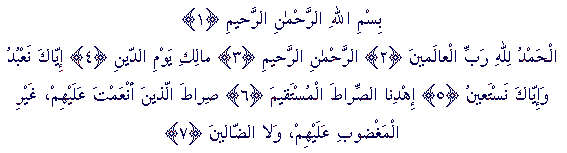
1.
In the name of God, Most Gracious, Most Merciful.
2.
Praise be to God, the Cherisher and Sustainer of the world;
3. Most Gracious, Most Merciful;
4. Master
of the Day of Judgment.
5. Thee do we worship, and
Thine aid we seek.
6. Show us the straight way,
7. The way of those on whom Thou hast bestowed Thy
Grace,
those whose (portion) is
not wrath, and who go not astray.
- translation by Abdullah Yusuf Ali
Al-Fātiḥa is the first sūrah (chapter) of the Qur'ān,
and was one of the earliest portions of the Qur'ān revealed
to the prophet Muḥammad by the angel Gabriel. The entire
Qur'ān was revealed in the years from 610 to 632 AD.
The Arabic word fātiḥa indicates an opening,
beginning or commencement, and is derived from
the root f-t-h which means to open, unlock, reveal, conquer.
The idea of opening or beginning is significant
in several ways: first, this is the opening verse of the Qur'ān,
secondly, this is said to be the first complete sūrah that was
revealed to the Prophet, but more importantly this name also
symbolizes the fact that the grace of Allāh has opened the doors
of Life to us and that as we begin to live our lives in harmony
with the ways of Allāh, the heart truly begins to open, thereby
allowing us to begin to allow the Divine Presence of the One
to consciously manifest openly through our daily lives, and
thus, it is we that have been opened by the grace of the Opener.
In many ways, the verses of the Fatiḥa are virtually
identical to a prayer that Jesus gave, called the Lord's
Prayer, as recorded in Matthew 6:9-13, and are also nearly identical
to the Gayatri Mantra which
was given in the Rig Veda. In each of these glorious prayers,
the opening lines sing praise of The One, while the final lines
acknowledge the gift of Divine Guidance on the path of righteousness
and understanding.
The Fatiḥa, the Lord's Prayer and the Gayatri
Mantra all illustrate a specific manner of communion with the
Divine. In each of these glorious supplications, the opening
lines are a recognition of the Glory and Majesty of the The
One, and then the prayer is closed by honoring the guidance
of the One who guides us all... not a selfish request for specific
things for the little "me", but a selfless recognition
of the wondrous gifts which are continually being bestowed
upon all of mankind.
For those who find it difficult to say the word Allah, it
may be helpful to note that in the Semitic language of Aramaic
which Jesus probably spoke, the Aramaic word which is translated
as God in the European bible was actually Alaha. According
to some linguists, the word Alaha which Jesus spoke would have
had the ending "a" softened or not pronounced at all,
leading to the pronunciation "alah". Since the Arabic
language was largely derived from the earlier Aramaic (much
the same as Aramaic was derived from the earlier Hebrew), the
modern Arabic word Allah is likely derived from the earlier
Aramaic pronunciation "alah". Indeed, Allah of the
Qur'an and Alaha of Jesus refer to the same One. In contrast,
the word God is a relatively new, and perhaps unfortunate,
European invention which has been the source of much misunderstanding
and conflict.
A deeper look into The Opening:
The following is the Fatiḥa, line-by-line in Arabic,
followed by a simple transliteration, and four well-known English
translations.
(Pronunciation guide: i as in sit, a as in
bat, u as in put, ā as the a in father, ī as the ee in
reel, ū as the oo in moot.)
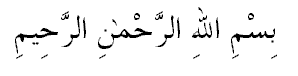
bismillāh ir-rahmān ir-rahīm
Yusuf Ali:
In the name of Allah, Most Gracious, Most Merciful.
Pickthall: In the name of
Allah, the Beneficent, the Merciful.
Shakir: In
the name of Allah, the Beneficent, the Merciful.
Muhammad Ali: In the name of Allah, the
Beneficent, the Merciful.
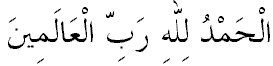
al-hamdulillāhi rabb il-ālamīn
Yusuf Ali:
Praise be to Allah, the Cherisher and Sustainer
of the worlds;
Pickthall: Praise
be to Allah, Lord of the Worlds,
Shakir: All
praise is due to Allah, the Lord of the Worlds.
Muhammad Ali: Praise be to Allah, Lord
of the worlds.
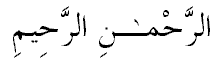
ar-rahmān ir-rahīm
Yusuf Ali:
Most Gracious, Most Merciful;
Pickthall: The Beneficent, the Merciful.
Shakir:
The Beneficent, the Merciful.
Muhammad Ali:
The Beneficent, the Merciful.
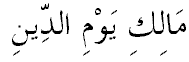
māliki yawm id-dīn
Yusuf Ali:
Master of the Day of Judgment.
Pickthall: Master of the Day of Judgment,
Shakir:
Master of the Day of Judgment.
Muhammad Ali:
Master of the day of Requital.
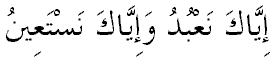
iyyāka na`budu wa iyyāka
nasta`īn
Yusuf Ali:
Thee do we worship, and Thine aid we seek.
Pickthall: Thee (alone) we worship;
Thee (alone) we ask for help.
Shakir: Thee
do we serve and Thee do we beseech for help.
Muhammad
Ali: Thee do we serve and Thee do we beseech
for help.
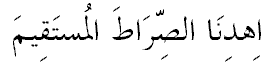
ihdinā s-sirāt al-mustaqīm
Yusuf Ali:
Show us the straight way,
Pickthall:
Show us the straight path,
Shakir: Keep
us on the right path.
Muhammad Ali:
Guide us on the right path,

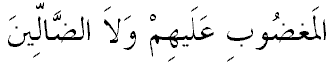
sirāt al-ladhīna an`amta `alayhim
ghayr il-maghdūbi `alayhim wa la d-dālīn
Yusuf Ali:
The way of those on whom Thou hast bestowed
Thy Grace,
those whose (portion) is not wrath, and who go not astray.
Pickthall: The path of those
whom Thou hast favoured;
Not the (path) of those who earn Thine anger
nor of those who go astray.
Shakir: The
path of those upon whom Thou hast bestowed favors.
Not (the path) of those upon whom Thy wrath is brought down,
nor of those who go astray.
Muhammad Ali:
The path of those upon whom Thou hast bestowed favours,
not those upon whom wrath is brought down,
nor those who go astray.
Going even deeper into 'The Opening'....
No simple literal translation can capture the magnificence
or the delicate nuances of these Arabic verses. Every word has
multiple levels of meaning, and each line brings new insights
and inspirations with every reading. To begin to discover the
deeper meanings of these verses, let's look at the deeper
meanings of the words, line by line:
(Pronunciation guide: i as in sit, a as in
bat, u as in put, ā as the a in father, ī as the ee in
reel, ū as the oo in moot.)
bismillāh ir-rahmān ir-rahīm
bismillāh = for the glory of Allah, in the name of Allah,
by means of the Light of Allah
There are three parts to this beautiful word: (see
also the bismillah
web page)
1) bi : by, for, by means of,
with the aid of, through (pointing towards the idea of what
happens next)
2) ism : name, reputation,
glory (root indicates light, vibration, essence)
3) Allah
ir-rahmān = the beneficent, the merciful, the compassionate,
the One who continually
showers all of creation with blessings, nourishment and
prosperity
Root r-ḥ-m:
womb, kinship, mercy, compassion, tenderness requiring the
exercise of beneficence.
ir-rahīm = the compassionate, the merciful, the One who
gives even more to those who live in loving harmony and
righteousness
Root r-ḥ-m:
womb, kinship, mercy, compassion, tenderness requiring the
exercise of beneficence.
al-hamdulillāhi rabb il-ālamīn
al-hamdulillāhi = all praise is to Allah, all praise
is for Allah
ḥamd :
praise, commendation, laudation
continual praise with a feeling
of pleasure, continual praise for the sake of Allah
(not for any specific action)
rabb = lord, master, owner, nourisher, cherisher, guardian
Root r-b-b: indicates the idea of fostering
something in such a manner as to help it to attain one condition
after another until it reaches the goal of completion
il-ālamīn = all the worlds, all that exists, all that
Allah has created
(plural
of 'alam)
ar-rahmān ir-rahīm
ar-rahmān = the beneficent, the merciful, the compassionate,
the loving One who
continually showers all of creation with blessings, nourishment
and prosperity
Root
r-h-m: womb, kinship, mercy,
compassion, tenderness requiring the exercise of beneficence.
ir-rahīm = the compassionate, the merciful, the One who
gives even more to those who live in loving harmony and
righteousness
Root r-h-m:
womb, kinship, mercy, compassion, tenderness requiring the
exercise of beneficence.
māliki yawm id-dīn
māliki = lord, master, owner, controller
Root m-l-k: to own, possess,
acquire, control, rule, have dominion over, lord over,
to be master of.
yawm = day, age, era, time, a period of time, moment
id-dīn = religion, faith, creed, sovereignty, submission,
belief, accountability
Root d-ā-n:
to be indebted, to owe, to be subject, be
under someone's power, owe allegiance; to repay. Bawa
Muhaiyaddeen said:
dīn means the light which is perfectly pure, dīn is what
existed in the beginning, the "ancient thing"
which was with God originally and is always with Him.
iyyāka na`budu
wa iyyāka nasta`īn
iyyāka = to you and only
you, to you alone, unto thee only, unto thee and none other
iyyā
: with you , unto you
ka : you (2nd person
masculine singular suffix)
na'budu = we worship,
we serve, we adore
na: (imperfect
prefix)
Root '-b-d: to serve,
worship, adore, venerate, submit
u: (indicative
suffix, 1st person plural)
wa = and, and also, while,
whilst, but, together, with
nasta'īn = we seek
help from
Root '-A-n:
to aid, to assistance, help
ihdinā s-sirāt al-mustaqīm
ihdi-nā = guide us, show us, lead us
ihdi: Root h-d-y: guide, show,
direct, be made aware, to be led back, to be rightly led
with kindness until one reaches the goal. This is also the
root of al-Hādī, the Guide, the Leader.
nā: pronoun, referring to we, or us.
s-sirāt = course, path, way
specifically, a path which is even, wide
and can be easily followed to the goal.
al-mustaqīm = straight, shortest, smooth, exact, right
Root q-m: get up. stand up,
stand erect: make straight, correct, reform, lift up, resurrect,
appoint, arouse. This is also the root of al-Qayyūm, the
Self-existing, the One who stands alone.
sirāt al-ladhīna an`amta `alayhim
ghayr il-maghdūbi `alayhim wa la d-dālīn
sirāt = course, path, way
specifically, a path which is even, wide
and can be easily followed to the goal.
al-ladhīna = those who, whoever
some early manuscripts read man rather than
al-ladhīna
an'amta = you have have bestowed grace, you have
favored, you have blessed
Root n-`-m: to bestow favor, be graciously disposed, to
make comfortable, to take great pains; to live in comfort
and luxury, life of ease
ta : you (subject,
2nd person masc sing)
'alayhim = unto them, upon them, over them
(prep) `alā on, upon, over, toward,
for
ghayr = unlike, different from, other than
il-maghdūbi = the recipient of anger, frustration, annoyance
Root gh-d-b: means to
be cross, angry, irritated, furious, annoyed, enraged.
'alayhim = unto them, upon them, over them
(prep) 'alā:
on, upon, over,
toward, for
wa la =and not, nor, neither, not even
d-dālīn = one who diverges from the
goal, one who goes astray, one who is diverted
Root d-l-l: means
to lose one's way, go astray, to err, to be misled,
to be deceived.
Armed with these definitions and your own insight, you
may enjoy creating your own poetic interpretation of al-Fātiḥa
in order to explore some of the many meanings and interpretations...
just go through the Fātiḥa word-by-word, inserting the
meaning of each word that seems to speak to your heart, such
as:
1) In the
name of Allah, the Ever-Merciful One Who is endlessly Beneficent,
and Who Graciously rewards those who live in Divine harmony,
2) every manner of this praise and joyful gratitude is for
the glory of Allah, the one Lord of all of creation,
3) the One who is forever lovingly beneficent and who rewards
those who surrender to a life of harmony and righteousness,
4) Owner of the Moment of Awakening,
5) You alone do
we adore and from You alone do we seek aid.
6) (You are)
guiding us on the glorious path of harmony and righteousness,
7) the way of those who have accepted your loving blessings
and not the way of those who have anger over them nor of
those who have gone astray.
- a rendering by wahiduddin
This has been only a brief introduction to al-Fātiḥa...
there are entire books written to explore the significance of
al-Fātiḥa more fully.
Click this link to hear al-Fatiha recited by
the renowned Saudi qari
Shaykh Saad al-Ghamdi.
References:
Tafsir Ibn Kathir (10 Volumes; Abridged) ,
commentary by ibn Kathir, in English
,
commentary by ibn Kathir, in English
Towards Understanding the Quran, Vol. I ,
by Sayyid Abdul'ala Maududi
,
by Sayyid Abdul'ala Maududi
Dictionary of the Holy Quran ,
by Abul Omar Mannan
,
by Abul Omar Mannan
Wishing
you love, harmony and beauty,
wahiduddin
updated:
18-Oct-2005
quran surah al-fatiha al-fatihah
bismillah ir-rahman ir-rahim
al-hamdulillahi rabbi al-alamin
ar-rahman ir-rahim
maliki yawm id-din
iyyaka na'budu wa iyyaka
nasta'in
ihdina as-sirat al-mustaqim
sirat al-ladhina
an 'amta 'alayhim ghayr il-maghdubi 'alayhim wa
la d-dalin



 Ask Inayat!
 ,
commentary by ibn Kathir, in English
,
commentary by ibn Kathir, in English ,
by Sayyid Abdul'ala Maududi
,
by Sayyid Abdul'ala Maududi ,
by Abul Omar Mannan
,
by Abul Omar Mannan