Getting It Right ...... or at least, Widely AcceptableObservations: Over the years, in many discussions with native speakers of Semitic, Persian and Indic languages as well as practitioners of various spiritual traditions, it seems that there are all too often words and sacred phrases used in the Dances of Universal Peace (DUP) and/or the papers of the Sufi Ruhaniat International (SRI) which may not be authentic. The intention of this article is not to criticize the sincere effort which has been put into the Dances by the devoted members of the DUP and the Ruhaniat, but rather the intention here is simply to "raise the bar" a little bit higher, striving for ever higher standards and greater authenticity as the Dances continue to spread to a world-wide audience. I've had the eye-opening good fortune to be able to talk to and/or correspond with a number of people who have described to me their own direct experience of how unpleasant and heartbreakingly painful it can be for them to be in a Dance circle while some of the deeply cherished sacred words and phrases of their spiritual tradition are misspoken or used out of their accepted context. The Dances are intended to be heart-opening, but when someone is so hurt or so deeply offended by the words used in a Dance, then there can be heart-closing, discomfort, and distress. We should strive to present the Dances in a manner which will unify and illuminate, not divide and distress. This article is based on my own personal observations, combined with what I've heard from various native-speakers and Dance leaders with whom I've communicated over the years. I hope that the ideas and examples presented in this article will help to bring greater authenticity and greater sensitivity to the Dances.
For those of us who don't know the intended "foreign" language, the pronunciation of the words really doesn't matter very much... God will surely reward us for our sincere and heartfelt intentions rather than our pronunciation. And in all likelihood, that's probably the case for the majority of the Dancers here in the USA. But, for those who happen to be familiar with a specific language or spiritual tradition, it's apparently quite disconcerting (or even heart-rending) for them to be urged to parade around singing lyrics which are (or seem to be) nonsense, or which are too dear to them to be uttered in such a context. In all fairness, Murshid Sam's original followers were primarily a small group of American college students who apparently had little or no experience with the foreign words and phrases which were used in Sam's dances, so pronunciation really didn't matter much. But today, as the Dances spread worldwide, we face a greater challenge as our Dance circle extends to include native speakers of those "foreign" languages as well as devout practitioners of those "foreign" traditions, some of whom may be deeply offended by our mispronunciation or even by our usage of their cherished sacred phrases in a Dance context. Can't we do better? Can't we find a way to help assure that native speakers of a language are neither puzzled nor offended by the words and phrases used in the Dances of Universal Peace? If we want the Dances and the Ruhaniat to spread worldwide, shouldn't we strive to assure that our words and phrases do not confuse, insult or offend a native speaker who actually knows the language and/or practices that religious tradition? How can the Dances reach their ultimate potential of being (as Murshid Saadi Klotz has written) "a path and a gift for all humans of all cultures" if any of the words and phrases, or the presentation, are confusing, insulting or otherwise offensive? Can we honestly say that we are "passing the torch" of a spiritual tradition if we have the words wrong, or if we present the words in a manner which is offensive to anyone attending the event? In a previous article entitled The Magic of the Accidental Nigun, I've written about the ways that our unfortunate mispronunciation of the "foreign" words in the Dances of Universal Peace can still bring great benefits to us as long as we have a deeply sincere sacred intention as we are using the words. For example, a group of white Anglo-Saxon Protestants can happily recite mispronounced (or even nonexistent) Arabic or Sanskrit or Hebrew words, and still derive great benefit due to the sincere sacred intention with which they recite those nonsensical words. However, the same cannot be said about the troublesome effects of such words upon an appalled native speaker of the "foreign" language, to whom our mispronunciation, or even our usage, of those cherished sacred words may seem to be grossly irreverent and may be utterly intolerable.
I hope that the thoughts and ideals expressed in this article will eventually serve to further enrich and enhance the Dances in the following ways: 1) Promote greater awareness about the difficulties caused when erroneous pronunciation and/or incorrect words are used in a Dance. 2) Promote greater sensitivity toward those attending a Dance who may be uncomfortable with the use of specific sacred phrases in a Dance context. 3) Help to encourage greater attention to authenticity, rather than "cultural strip-mining".
But, what is "correct"? How can we define "correct"? When are we being sensitive enough to the sacred traditions of those who are present in the dance circle? When is the pronunciation "good enough"? These are difficult issues. Yet they are issues which must be explored if the Dances are to be embraced by a world-audience. There are surely many different aspects to such complex questions, and we should certainly look at each individual case with great caution to avoid "throwing out the baby with the bath water". Here are some of the many factors to be considered:
Here in the United States, for example, there is great variation in the pronunciation of English words, to the extent that someone from the state of Kansas may at times have great difficulty understanding someone from the hill country of the state of Tennessee, largely due to different pronunciation of vowels. For example, I once heard a preacher from the Southern USA say: "Whatever your problems may be, always take refuge in the Lard!" And while that statement did make a very amusing mental image of taking refuge in lard, it was merely caused by her regional pronunciation of the vowel "o" in Lord using somewhat of an "a" sound. Clearly, using the spelling "take refuge in the Lard" in a Dance would not convey the intended spiritual message, and anyone familiar with the English language (or capable of using a dictionary) would surely write the intended form "take refuge in the Lord" That is, "take refuge in the Lard" is NOT an authentic "transmission" of the desired phrase. It may, in fact, be exactly what the person said, but it is not the intended phrase. The phrase, "take refuge in the Lord" is clearly the intended "transmission". We must strive to always use the intended words and phrases in the Dances and the Ruhaniat papers, regardless of how they may have been distorted by the accent (or lack of skill) of the original source. Similarly, one person in India might refer to Lord Rāma, while another speaks of Rām, and they both recognize that are speaking of the same one, with Rāma simply being a classical (Sanskrit) form, and Rām being a more contemporary form (such as Hindi). Yet someone who speaks of Lord Rum will simply be speaking nonsense. That is, there are "normal" variations for many words, but then there are other variations which are simply erroneous. We should strive to weed out whatever falls into the category of erroneous. In many languages, the major indicator of a long vowel is not merely the sound, but rather it is the duration of the sound. This can lead to great confusion when the relative length of the vowels, or the originally accented syllables, are altered in order to fit the rhythm of a Dance melody. For example, the Arabic/Farsi/Urdu word "kun" (with a short "u") means "Be!", while the similar Farsi/Urdu word "kūn" ("koon", with a long "u") means "buttocks" or "anus".
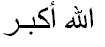
And as if the regional variations were not enough confusion, it is also common for words from "foreign" languages to be assimilated into any given language in a somewhat modified form. For example, some 2000 years ago there was a great teacher called Yeshua, but in today's modern English we call him Jesus. For the step-by-step details of this rather bewildering name transformation, please see my web page entitled Yeshua. So, is the name "Jesus" "wrong"? It all depends on what language is being used. For example, in English the name Jesus is quite commonly used, but in Aramaic that was not his name. Similar transformations have occurred as Arabic words have spread around the world and have been assimilated into other languages. When the Arabs conquered the Persian empire, many Arabic words were assimilated into the language of that empire, which is now called Farsi or Persian. And in turn, many Farsi words were melded with Sanskrit to form Hindi and Urdu. Both Farsi and Urdu continue utilize the Arabic alphabet (with some additional letters added), so that the Arabic-based words are commonly written exactly the same in Arabic, Farsi and Urdu, yet they are often pronounced much differently! The Persians did not have some of the Semitic phonemes, so they simply changed the pronunciation of the letters of the Arabic alphabet to suit their traditional manner of speech, including changes in the pronunciation of short vowels. Thus, the phrase written in Arabic script as:
which in the USA would commonly be transliterated as allāhu akbar, is also written (and pronounced) in various ways such as allaho akbar or allahu ekber in regions which speak Farsi, Urdu or Turkish. That is, the short "u" often turns into an "o" in Farsi/Urdu, and the short "a" or short "i" may turn into "e" in Turkish. Clearly this is no longer purely Arabic, but these countries don't speak Arabic, and have simply adapted the original Arabic to suit their own needs. Certainly allahu ekber is not Arabic, but does that make it "wrong"? In all likelihood an Arab would hardly recognize some of a Turkish dervish's pronunciation of words which were derived from Arabic, such as mevlana which is based on the Arabic maulana, or ashk which is derived from the Arabic 'ishq, but that's just what happens to language. We borrow each other's words, and pronounce them in our own way. So, we don't need to change the word mevlana, we just need to recognize that it's a Turkish pronunciation. As another example, consider the word written in Arabic script as:
For someone who speaks Urdu or Farsi, that word would generally transliterated as, and pronounced as, "zikr", while for an Arabic speaker the exact same word could be transliterated as "dhikr" and typically pronounced as "thikr". Therefore, in the Dances, it is crucial to acknowledge the specific spiritual tradition which is being honored, and then strive to use the pronunciation that a native speaker in that tradition (and that part of the world) would use. That is, it would be quite incorrect to change a Turkish sacred phrase using "ashk" to " 'ishq", even though it is certainly derived from Arabic. And likewise it would be incorrect to change a Farsi/Urdu sacred phrase using the word "zikr" to the Arabic "dhikr" even though it is clearly derived from Arabic. In the Dances, we need to strive to correctly indicate what language we are using for each sacred word and phrase.
Another issue that can be quite bewildering is the gradual change of language both over time, and over distance. For example, the basic root of the Indic languages is Sanskrit, but today there are literally hundreds of dialects spoken in India, some of which cannot even be understood by speakers of another dialect a few hundred miles away. And in the Semitic languages, much the same has occurred. For example, the classical Arabic used in the Qur'an has given way to a wide variety of dialects of Arabic which have such diversity that a native of Syria might be unable to understand the colloquial speech of someone from Morocco. Thus a sacred phrase used in the daily life of a Moroccan might be nearly unrecognizable, and even perhaps seem "wrong" to someone, for example, from Syria. While it might be "tidy" to always employ a widely accepted classical language, we certainly must remain open to colloquial words and phrases as are used in the everyday language of various religious traditions. Just because a tradition or a certain sacred phrase is rare does not make it wrong. This is surely a very difficult issue, and may even represent an insurmountable barrier to verification of some sacred words and phrases, since there are probably very few (if any) people who have the breadth of experience and expertise to reliably tell the difference between "rare" and "wrong" in the colloquial speech of uncommon dialects.
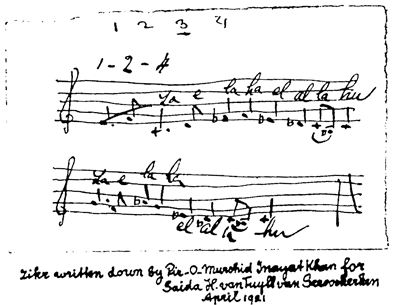
And then there is the issue of how to write words which originally used another alphabet, an art which is called transliteration (the art of converting each character of an alphabet to characters based on some other alphabet). For example, see the Wikipedia article on Arabic transliteration. Unfortunately, there are no truly universal standards for transliteration, and the "foreign" words that we see in various texts are often written in a confusing combination of transliteration, phonetics and personal preferences. The art of transliteration is made quite confusing by the fact that different countries, as well as different organizations, have proposed a wide variety of different schemes for transliteration. In the USA, the Library of Congress has set our national standards for transliteration. Note that transliteration is merely a way to represent one alphabet using the symbols of a different alphabet... that is, transliteration is not intended to be phonetic. As an example of the confusion which can so easily be caused by transliteration, consider this handwritten note from Hazrat Inayat Khan documenting the zikr which he taught to his students:
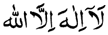
In the illustration above, we see the lyrics associated with each note written as: "la e la ha el al la hu", and one might be tempted to pronounce the "el" much like the Spanish "el" or in the Hebrew "elohim". Fortunately, to resolve any uncertainty regarding the intended pronunciation, we have the good fortune to have an audio recording of Hazrat Inayat Khan singing those very words. By listening to that recording of Inayat Khan's own words, the intended pronunciation becomes quite clear, and it is not an "el" sound such as we might know from the Spanish "el" or the Hebrew "elohim". Clearly this is a quite conventional recitation of the Arabic phrase which is written as:
This phrase from the Qur'an is often called tahlīl (meaning rejoicing or jubilation), and would be transliterated by contemporary USA standards as lā ilāha illā allāh. Surely we should promote the use of the intended phrase rather than promote the use of an unclear and misleading transliteration. That is, we should strive to honor our teacher's intention. If, for example, one's teacher mispronounces a word, that does not mean that we should perpetuate the error... to do so would be an insult to our teacher's intention. We should quietly and gracefully correct the error and move on. Inconsistent pronunciation and/or inconsistent transliteration can also be also a problem. Consider for example, Murshid Sam's Three Wazifa Dance which uses the phrases "subhanallah al-hamdulillah allaho akbar". Note that the original Arabic character "damma" (used as a nominative case indicator) is transliterated as "u" in al-hamdulillah, but is then transliterated as "o" in allaho akbar. So we end up with a hodgepodge of different transliteration systems which does not accurately represent how either a native speaker of Arabic or a native speaker of Urdu would typically pronounce the three wazaif. The first two written forms approximate an Arabic speaker, while the last one is more of a Farsi/Urdu form. That seems to be just sloppy work. (And in the case of that Dance is made even worse by the distortion of the natural cadence and accent of the word subhanallah.) For enduring results, it seems that the DUP should adopt consistent standards for transliteration of foreign words and phrases used in the Dances (and in Murshid Sam's published papers).
In addition to the aforementioned typical morphing of words and the transliteration issues, there may also be a few words used in the Dances which are simply mistakes, perhaps due to misunderstanding of the term or perhaps due to failure to properly recall the original term. I'm not any language expert, but native speakers have told me that some of the words seem to be mistakes. The examples which are perhaps most perplexing are Murshid Sam's unusual phrases "la ilaha el il allahu" and "la ilaha il allah". In Sam's defense, some of his students amusingly claim that he learned a Pakistani version of the original phrase, and others say that he learned it Egypt, but there is also the possibility that Murshid Sam (or his source) simply recalled it wrong and never took the time to verify the phrase in the original language. Murshid Sam was a mystic, he had a bigger picture in mind, and details such as pronunciation were probably not very important to him. For further details regarding the derivation and common pronunciation of this beautiful phrase, please see my web page devoted to lā ilāha illā allāh. The phrase "ishq allah mahbud lillah" is another example of what appears to be simply a mistake. For more details regarding this mantric phrase, please see my web page on ishq allāh ma'būd allāh. Some of Murshid Sam's devotees seem to take the defensive attitude that their guru couldn't have ever made a mistake. But Murshid Sam was certainly human, and humans do make mistakes... that's how we all learn. It's no big deal to make a mistake... it's only a big deal when we refuse to correct it. I've heard a number of Murshid Sam's original students talk about his frequent mispronunciation of words as simple as the name of the Hindu deity Rām. And other of his students have commented on Sam's lack of concern about details by offering a variety of examples such as his occasional wearing of mis-matched socks of different colors, or having only half of his face shaven. These comments are not intended as any sort of criticism of Murshid Sam, but rather simply a recognition of who he was. Murshid Sam was a mystic, and some types of details were apparently not very important to him. Murshid Sam's heartfelt Arabic from the hilltop as recorded in the 1970's film Sunseed offers an opportunity for anyone interested to directly hear some of Sam's own words. No doubt his sincere and heartfelt prayer was well received by the Ever-Merciful One, but according to some of my Arabic/Farsi-speaking friends, those words are mostly nonsense. In Murshid Sam's defense, when he was merely leading a small troupe of hippies in San Francisco, he could use any "foreign" word, give the word an inspiring definition of what it should mean to them, and let that meaning dance its way into their hearts. However, if we truly want the dances to spread worldwide, we must now make certain that the words and phrases do not offend the sensibilities of those who actually know that language and/or practice that religious tradition. And, as if some of Murshid Sam's unusual words were not enough, there are also more recent songs and dances which been created without knowledge of the intended language and are thereby unwittingly "transmitted" nonsense. For example, I really enjoyed a song called "Allah Ya Batin"... but then, I was told that when "batin" is pronounced as batīn (bateen, with long "i" after the "t"), as it is in the song, it generally means fat, corpulent, gluttonous, thereby calling upon Allāh O' Gluttonous One! In contrast, the intended word was bātin (baatin, with long "a" before the "t") which means hidden. There is quite a difference! As another simple example, in the Dances and the Ruhaniat papers, the word "Rassoul" appears several hundred times... but that is a rather nonsensical misspelling of the Arabic word which would be better transliterated "rasūl", since there is only one "s" and no "o" in the original Arabic/Farsi/Urdu word.
Admittedly, most of us are unlikely to get it perfect, since there are sounds in some languages (especially in the Semitic languages) which a native English speaker has never previously encountered, and which many of us are unlikely to say correctly any time soon. So, we need to be prepared to accept pronunciation of "foreign" words which is simply "good enough". However, simply not caring, not being concerned, is not good enough. Without thoughtfully mastering a "good enough" pronunciation, we're doing little more than insulting the tradition which we had set out to honor.
Clearly it is best if one learns the sacred word or sacred phrase from a knowledgeable living teacher who fully comprehends the deeper meaning as well as the correct pronunciation, intonation and spelling. Sadly, however, there are some Dances which have been created using words and phrases merely found in best-seller books, with no authentic guidance from a living teacher regarding the authentic pronunciation or usage. When one encounters an appealing "foreign" word or phrase upon which to base a new Dance, then it will be highly beneficial to seek out an authentic teacher of that tradition from whom to learn the full breadth of meaning, as well as to learn to proper pronunciation, intonation, usage and spelling. Anything less does not seem to me to be an authentic transmission. Such lack of authentic, direct transmission from a living teacher is an unfortunate situation of "cultural strip-mining" which can compromise both the intent and the integrity of the Dances.
Another issue which we need to be constantly aware of is that some people attending a Dance may be greatly offended by having certain sacred words sung with music and/or in the context of a dance event. For them, their holy ground is too sacred to be stepped on in such a manner. For example, in many Islamic areas of the world, the idea of singing a sacred phrase such as bismillāh al-rahmān al-rahīm or lā ilāha illā allāh along with guitars and dancing might be quite offensive and considered as utterly irreverent. So, we have two separate, yet related issues. Dance leaders must be sensitive to the cultural values of those attending the Dance, and simultaneously we must also strive to assure that our words and phrases are authentic.
In the past, I've talked briefly with Pir Shabda Kahn about this issue, and at that time he was quite resistant to creating what he called "dance police". And, according to a variety of sources (including my own experiences), Murshid Saadi Klotz has also firmly resisted changes to any of the unusual (or nonsensical) phrases attributed to Murshid Sam. But, nonetheless, I believe that we really need to insure that the words and phrases used in the Dances of Universal Peace (and the papers of the Sufi Ruhaniat International) will neither offend nor confuse a typical native speaker of that language or a devout practitioner of that religious tradition. As a start, I hope that the bizarre phrases "la ilaha el il allahu" and "ishq allah mahbud lillah" will be carefully examined, and, unless there is compelling evidence of their authenticity, simply converted to the more universal forms lā ilāha illā allāh and ishq allāh ma'būd allāh . It seems to me that the longer we wait to tidy up our sacred phrases, the deeper we dig the hole...
Apr 30, 2009 revised Sep 8, 20125
|