The Hundred Verses of Advice
of Padampa Sangye
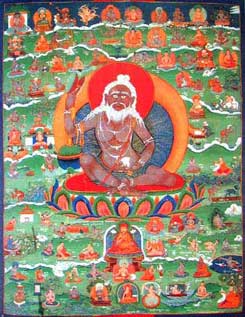 The Hundred Verses of Advice of Padampa Sangye are utterly amazing for their clarity, depth, breadth and brevity.
Padampa Sangye (known in India as Paramabuddha) was from southern India, and traveled widely in India, Tibet and China, until his death around 1117 AD. It is widely believed that Padampa Sangye was an incarnation of the 8th century monk Kamalashīla, one of the early teachers of the Dharma in Tibet.
When the Indian sage Padampa Sangye arrived in Tibet, he found the people in the area of Tingri, which is on the Tibetan side of Mt. Everest, to be especially amenable to his instruction. He therefore settled in Tingri and established a monastery.
The following text was translated from Tibetan by John Canti of the Padmakara Translation Group, and may be found along with detailed commentary by the late Dilgo Khyentse in:
Dilgo Khyentse, The Hundred Verses of Advice of Padampa Sangye
Translated by Padmakara Translation Group.
Published by Shechen Publications, New Delhi, 2002.
ISBN 81-7472-088-1
Preface
Homage to the teacher!
Fortunate practitioners gathered here in Tingri, listen!
Just as worn-out clothes can never again be made as new,
It's no use seeing a doctor once you're terminally ill;
You'll have to go. We humans living on this earth
Are like streams and rivers flowing toward the ocean -
All living beings are heading for that single destination.
Now, like a small bird flying off from a treetop,
I, too, will not be here much longer; soon I must move on.
1
If you spend the present meaninglessly and leave with empty hands,
People of Tingri, a human life in the future will be very hard to find.
2
To apply yourselves with body, speech and mind to the sacred Teachings,
People of Tingri, is the best thing that you can do.
3
Give your very life, heart and soul to the Three Jewels [the Buddha, the Dharma, and the Sangha],
People of Tingri, and their blessings cannot but arise.
4
Forget your goals for this life - concentrate instead on lives to come.
People of Tingri, that is the highest goal.
5
Families are as fleeting as a crowd on market day;
People of Tingri, don't bicker or fight.
6
Wealth and poverty, like a magic show, just seduce and deceive;
People of Tingri, don't let the knot of avarice bind you.
7
This body's just a bag containing various kinds of filth;
People of Tingri, don't pamper it and spruce it up so.
8
Family and friends are no more real than a magic show;
People of Tingri, in your fondness for them don't tie yourself down.
9
Country and land are like a nomad's pastures
People of Tingri, don't cling sentimentally to them.
10
As parents, all beings in the six realms have cared for you;
People of Tingri, don't relate to them with your ideas of "I" and "mine".
11
The day you were born, your death began approaching;
People of Tingri, remember: there is never any time to spare.
12
Fundamentally there's no delusion, it's an ephemeral occurrence;
People of Tingri, look at the nature of what it produces.
13
Without distraction apply yourselves to the sacred Dharma;
People of Tingri, after death it will guide you on the path.
14
The truth of cause and effect ensures that actions yield their full result;
People of Tingri, avoid all actions that are negative and evil.
15
Leave all your activities behind like a country in a dream;
People of Tingri, just put non-action into practice.
16
The very thing you feel attached to, let go of it, whatever -
People of Tingri, there isn't anything that you need.
17
Since you won't be staying in this world forever,
People of Tingri, make your preparations for the journey now.
18
If you first finish what you have to do, you'll never get to Dharma;
People of Tingri, while you're thinking about it, practice straight away.
19
Inside the forest, monkeys may be living happily at ease,
People of Tingri - but at the edges forest fires are closing in all round.
20
Birth, sickness, ageing and death flow on, a river without ford or bridge;
People of Tingri, have you prepared yourselves a boat?
21
In the narrow defiles of birth, death and the intermediate state
Bandits await - the five poisonous emotions - sure to ambush you;
People of Tingri, avail yourselves of the teacher as your escort.
22
Your never-failing source of refuge is the teacher;
People of Tingri, carry him constantly on the crown of your head.
23
If your protection is the teacher, you'll reach wherever you aspire to go;
People of Tingri, cultivate devotion as the fare you pay for the journey.
24
Those who get wealthy get miserly too;
People of Tingri, give generously without being partial.
25
Whoever gets power acts sinfully, too;
People of Tingri, abandon all desire for rank and power.
26
Those with rank and riches are never happy and at ease;
People of Tingri, get ready to claw at your chest in anguish.
27
In the next world, there are neither family nor friends;
People of Tingri, place your confidence in the Dharma.
28
If you wander in distraction, you'll waste the freedoms and advantages of human life;
People of Tingri, make a resolute decision now.
29
While you're busy being distracted, the demon of Death will catch you;
People of Tingri, practice from this very moment onwards.
30
When will the demon of Death appear? There is no easy way to tell;
People of Tingri, right now be always on your guard.
31
The day you die, there's no one who'll protect you;
People of Tingri, be ready to have yourselves alone to count on.
32
If you reflect on death, there's nothing you will need;
People of Tingri, always keep your death in mind.
33
Like lengthening shadows as the sun sinks low,
The demon of Death relentlessly draws nearer;
People of Tingri, quickly! Get away from him!
34
The morning's ravishing flower will wither by nightfall;
People of Tingri, don't put your hopes in your body.
35
Even if resembling, while alive, the children of the gods,
Once dead they are more frightful than a demon horde;
People of Tingri, you've been deceived by these illusory bodies.
36
Visitors to market day, their trading finished, on the morrow have dispersed;
People of Tingri, your friends will part from you, be certain.
37
Since the scarecrow conjured up by magic is sure to tumble down;
People of Tingri, act now according to the linking of effect with cause.
38
For sure, the vulture of your mind will one day fly away;
People of Tingri, now is the time to soar up to the heights.
39
All beings of the six realms have cared for you as parents;
People of Tingri, towards them cultivate your love and compassion.
40
Hate for enemies is samsara's hallucination, caused by actions;
People of Tingri, transmute your hatred and your hostile mind.
41
Prostration and circumambulation purify obscuration of the body;
People of Tingri, abandon all your worldly physical work.
42
Recitation and taking refuge purify obscuration of the speech;
People of Tingri, abandon all your ordinary conversation.
43
Fervent devotion purifies habitual tendencies of the mind;
People of Tingri, meditate on the teacher above your head.
44
Your flesh and bones took form together, but in the end are sure to separate;
People of Tingri, do not believe that you will live forever.
45
Capture that most sublime of countries, the constant land of the natural state;
People of Tingri, where there is no transition or change.
46
Enjoy that most sublime of riches, the treasure of the nature of mind;
People of Tingri, which cannot ever be depleted.
47
Savor that most sublime of foods, the exquisite taste of meditation,
People of Tingri, which abolishes the pangs of hunger.
48
Imbibe that most sublime of drinks, the ambrosia of mindfulness,
People of Tingri, whose flow is never interrupted.
49
Rely upon that most sublime companion, primordial awareness wisdom,
People of Tingri, from which you never can be parted.
50
Seek for that most sublime of progeny, the young child pure awareness,
People of Tingri, for which there is no birth or death.
51
In a state of emptiness, whirl the spear of pure awareness;
People of Tingri, the view is free of being caught by anything at all.
52
In a state without thoughts, without distraction, abandon the watcher;
People of Tingri, the meditation is free of any torpor or excitement.
53
In a state of natural spontaneity, train in being free of any holding back;
People of Tingri, in the action there is nothing to abandon or adopt.
54
The four bodies, indivisible, are complete in your mind;
People of Tingri, the fruit is beyond all hope and doubt.
55
The root of both samsara and nirvana is to be found within your mind;
People of Tingri, the mind is free of any true reality.
56
Desire and hate appear, but like birds in flight, should leave no trace behind;
People of Tingri, in meditation be free of clinging to experiences.
57
The unborn absolute body is like the very heart of the sun -
People of Tingri, there is no waxing or waning of its radiant clarity.
58
Thoughts come and go like a thief in an empty house -
People of Tingri, in fact there is nothing to be gained or lost.
59
Sensations leave no imprints, like drawings made on water;
People of Tingri, don't perpetuate deluded appearances.
60
Thoughts of attachment and aversion are like rainbows in the sky;
People of Tingri, there is nothing in them to be grasped or apprehended.
61
Mind's movements dissolve by themselves, like clouds in the sky;
People of Tingri, in the mind there are no reference points.
62
Without fixation, thoughts are freed by themselves, like the wind,
People of Tingri, which never clings to any object.
63
Pure awareness is without fixation, like a rainbow in the sky;
People of Tingri, experiences arise quite unimpededly.
64
Realization of the absolute nature is like the dream of a mute;
People of Tingri, there are no words to express it.
65
Realization is like a youthful maiden's pleasure;
People of Tingri, the joy and bliss cannot be described.
66
Clarity and emptiness united are like the moon reflecting in water;
People of Tingri, there is nothing to be attached to and nothing to impede.
67
Appearances and emptiness inseparable are like the empty sky;
People of Tingri, the mind is without either center or periphery.
68
The mind with no thought and no distraction is like the mirror of a beauty;
People of Tingri, it is free of any theoretical tenets.
69
Awareness and emptiness inseparable are like reflections in a mirror;
People of Tingri, nothing is born there and nothing ceases.
70
Bliss and emptiness inseparable are like the sun lighting up the snows;
People of Tingri, there is nothing there to apprehend.
71
Deluded talk will fade without a trace, like echoes;
People of Tingri, in sound there is nothing to be grasped.
72
Happiness and suffering, through a mechanism like the sounding of a lute's body and strings,
People of Tingri, are produced when actions are combined with necessary conditions.
73
The natural freedom of samsara and nirvana is like a children's game;
People of Tingri, have a mind without any aims.
74
Your notions of the outer world derive from the mind within;
People of Tingri, let the solid ice be melted into liquid.
75
The mechanism of ignorance is like the gush of a meadow spring;
People of Tingri, it cannot be halted by obstructing it.
76
The delusions of samsara and nirvana are like coming face to face with an enemy;
People of Tingri, as your ally practice virtue.
77
The natural clarity of the five kayas [aspects of enlightenment] is like the expanse of a continent of gold;
People of Tingri, there is no hope or doubt, attachment or aversion.
78
With its freedoms and advantages, human life is like a treasure island;
People of Tingri, do not come back an empty-handed failure.
79
The practice of the Great Vehicle is like a wish-fulfilling gem;
People of Tingri, however hard you search, it would be difficult to find again.
80
For this life, come what may, you'll have enough to eat and clothe yourself;
People of Tingri, put everything you have into practicing the Dharma.
81
While you are young, practice hard and with austerities;
People of Tingri, once you're old your constitution won't withstand it.
82
When emotions arise, bring antidotes to bear on them;
People of Tingri, let free all concepts in their very nature.
83
Think from time to time of all the defects of samsara;
People of Tingri, that will make your faith become much clearer.
84
Right now, develop diligence and stand your ground;
People of Tingri, when you die it will guide you on the path.
85
If you're not free now, when will you ever get to be free?
People of Tingri, your chance to eat comes only one time in a hundred.
86
Life is so ephemeral, like the dew on the grass;
People of Tingri, don't yield to laziness and indifference.
87
From where you are now, should you lose your footing,
People of Tingri, it will be hard to find a human life again.
88
The Buddha's teaching is like the sun shining through the clouds;
People of Tingri, now is the one time that it is present.
89
You say such clever things to people, but don't apply them to yourself;
People of Tingri, the faults within you are the ones to be exposed.
90
That faith succumbs to circumstance is only a short step away;
People of Tingri, contemplate samsara's imperfections.
91
Frequenting evil friends is bound to make your own behavior evil;
People of Tingri, abandon any friendships that are negative.
92
Frequenting virtuous friends is bound to make your own good qualities arise;
People of Tingri, follow your spiritual teachers.
93
Deception and lies deceive not only others, but yourself as well;
People of Tingri, as witness take your own conscience.
94
Delusion born from ignorance is the worst disaster-bearing demon;
People of Tingri, hold fast to your vigilance and mindfulness.
95
If you don't hold on to the three or five poisons [desire, hatred, ignorance, jealousy, pride], the path is near;
People of Tingri, generate powerful antidotes against them.
96
If your perseverance has no strength, you will not reach Buddhahood;
People of Tingri, make sure that you don that Armor.
97
Habitual tendencies, being old acquaintances, keep on coming back;
People of Tingri, don't go on following the past.
98
If your understanding and realization are weak, pray to your lord teacher;
People of Tingri, and deep meditation will be born in you.
99
If you aspire to happiness in future, accept your present trials;
People of Tingri - then Buddhahood is right here just beside you.
100
This old Indian master will not stay in Tingri, he will go away;
People of Tingri, it is now that you must clarify your doubts.
101
I myself have practiced without distraction;
People of Tingri, you too should follow this example.
Note:
If you have enjoyed these excerpts and would like to read the detailed verse-by-verse commentary by Dilgo Khyentse Rinpoche, you can purchase the complete book:
Dilgo Khyentse, The Hundred Verses of Advice of Padampa Sangye
Translated by Padmakara Translation Group.
Published by Shechen Publications, New Delhi, 2002.
ISBN 81-7472-088-1
I bought my copy of the book from the on-line bookstore at: https://www.namsebangdzo.com
A newer version of the text is more widely available:
Dilgo Khyentse & Padampa Sangye, The Hundred Verses of Advice
Translated by Padmakara Translation Group.
Published by Shambhala, Boston, 2006
ISBN-13 978-1590303412
posted July 09, 2003... updated 9-Nov-2024