
header pic header text
BOWL OF SAKI
BOWL OF SAKI - EMAIL
SPIRITUAL MESSAGE OF
      HAZRAT INAYAT KHAN
INTRODUCTION TO
     HAZRAT INAYAT KHAN
VIEWPOINTS...
        by wahiduddin
MUSIC...
        by wahiduddin
MEDITATION...
        by wahiduddin
POETRY...
        by wahiduddin
ROOTS OF WORDS...
       by wahiduddin
QUR'AN
99 NAMES OF ALLAH
       The Beautiful Names
SUFI TOPICS
MEDITATION
MANTRA
SWAMI RAMDAS
MU'INUDDIN CHISHTI
'ABDULLAH ANSARI
JALALUDDIN RUMI
SWAMI VIVEKANANDA
SAINT FRANCIS OF ASSISI
PADAMPA SANGYE
SHANTIDEVA
JAMES ALLEN
OTHER INTERESTING TOPICS
DANCES OF UNIVERSAL PEACE
WEB LINKS
FAVORITE BOOKS
WEB SITE INFORMATION
CONTACT:


Devotional Phrases in Arabic

updated 25-Aug-2010
 

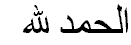
al hamdulillâh   
 
al-hamdulillah

al = the
hamd = praise, commendation, extolling the virtues of
u = suffix denoting that hamd is the subject of this phrase
li = to, for, unto, on account of
llâh = allâh
 

 All praise is for Allâh.

 All praise is to Allâh.

  (hw238)


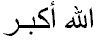
allâhu akbar   
    
allahu akbar

allâh = allâh
u = suffix denoting that allâh is the subject of this phrase
akbar = greater, greatest in estimation, rank or dignity; older, senior-ranking;

Allâh is great.

Allâh is most great.

Allâh is the greatest great.

(this phrase is called takbîr, meaning praise, glorification)    (hw949)


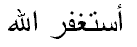
astaghfirullâh   
  
 astaghfirullah

asta = derived verb prefix which denotes seeking, asking
ghfir = forgiveness for past sins, and/or protection from future sins
u = suffix denoting that ghfir is the subject of this phrase
-llâh = allâh


I am seeking forgiveness from Allâh.

I seek Allâh's protection from committing sins.

astaghfirullâh is sometimes said in response to a compliment, as if to say Allah please protect me from pride and vanity.

Please see ghaffr on the wazifa page for more meanings of the root gh-f-r.   (hw793)


bismillâh ir-rahmân ir-rahîm   
 
bismillah

bi = with, to for, in, through  
smi = distinguishing mark, name, light, vibration, essence

-llâh = allâh
ir = the
rahmân = most beneficent, merciful
ir = the
rahîm = most compassionate


In the name of Allâh, most beneficent and most compassionate.

For the glory of Allâh, most merciful and most compassionate.

With the guidance of Allâh, most beneficent and most compassionate.

 Please see the bismillah page for further details.  (hw504, 498, 384)


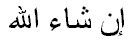
in-shâ'-llâh   
insha'allah

in = if
shâ' = wish, want
llâh = allâh


If Allâh wills (something). As Allah intends.

(said in referring to the future)


hawla wa lâ quwwata illâ billâh 
    
la hawla

lâ = no, not, none, neither
hawla = change, motion, transformation, power
wa = and
lâ = no, not, none, neither
quwwata = strength, power, potency, intensity
illâ = but, except
bi = with, to, for, in, through
llâh = allâh


There is no transformation or potency except through Allâh.

There is neither change nor power except through Allâh.

There is no power or strength except through Allâh.

Please see the tahwil page for more information


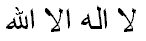
lâ ilâha illâ-llâh      
la ilaha illa-llah

lâ = no, not, none, neither
ilâha = god, deity, object of worship
illâ = but, except (illâ is a contraction of in-lâ, literally if not)
-llâh = allâh


 There is no deity other than Allâh.

 There is nothing to worship except Allâh.

 There is nothing to revere other than Allâh.

This phrase is often called the tahlîl and was given to us in the Qur'an 47:19.

Please see the tahlil page for more information.


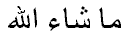
mâ-shâ'-llâh         
masha'allah

mâ; = what, whatever, that
shâ' = wish, want, willingness, intent
llâh = allâh


Common Usage: How wonderful are the works of Allâh.

Literally: Whatever Allâh has intended. That which Allâh has willed.

(often said when one witnesses something good)  
(hw579)


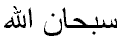
subhâna -llâh        
   
subhanallah

subhân = praised, glory be to; all-perfect, all-pure, all-glorious
-llâh = allâh

Holy is Allâh.

All glory be to Allâh.

Allâh is far from any imperfection.

a declaration (or celebration) of the absolute perfection (or glory) of Allâh.

   (see example of usage in Qur'an 23:91)     (hw457, ewl1290)


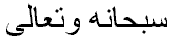
subhâna wa ta'alâ     
  
subhana wa ta'ala

subhâna = praised, glory be to
wa = and
ta'alâ = be exalted, raised above, enthroned


 (Allâh is) Praised and exalted.


'ishq allâh ma'bûd allâh    
   
   ishq allah

'ishq = unconditional love, divine love;
ma'bûd = beloved, worshiped, adored.

A mantra, literally saying that Allâh is Love, Allâh is Beloved. Poetically interpreted by Hazrat Inayat Khan as: God is love, lover and beloved.

(hw719, 686)


See also: Glossary of terms used by Hazrat Inayat Khan


Notes:

1. The English transliteration given above includes some Arabic rules of grammar for pronunciation. For example, the phrase written in Arabic as bismi allâh al rahmân al rahîm, is pronounced as bismi-llâh ir-rahmân ir-rahîm.

2. In the text above, note that the initial A of "Allah" is often absorbed or modified by a preceding vowel. The hyphen is used only for clarity by separating component parts of phrases.

3. Pronunciation of the vowels varies in different countries, and is further complicated by the fact that the short vowels are seldom written except in religious or scholarly texts. Also, the pronunciation of some vowels varies depending upon the adjacent letters.

4. For compatibility with most web browsers, the long vowels are indicated as â (pronounced like the a in father), î (pronounced like the ee in deep) and û (pronounced like the oo in moot).

5. The notations such as (hw238) refer to the page number in the Hans Wehr Arabic-English Dictionary.


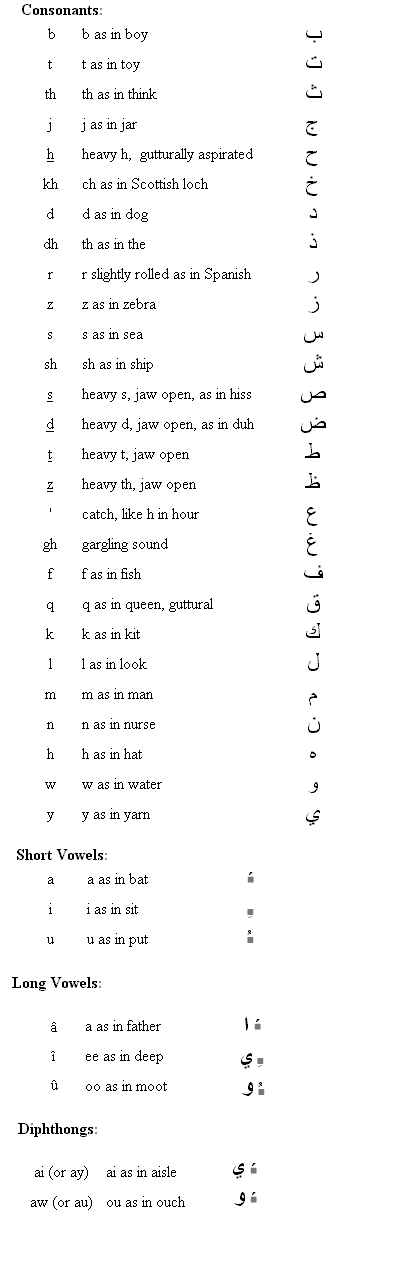
Simplified Transliteration and Pronunciation:

transliteration guide


1) This is only a simple and somewhat incomplete transliteration guide, for a more complete set of transliteration rules, see, for example,  the ALA-LC Romanization Tables used by the Library of Congress, available at  http://www.loc.gov/catdir/cpso/roman.html

2) The pronunciation of vowels, diphthongs and some consonants varies considerably from region to region


Reference Texts
:

Dictionary of the Holy Qur'ân, Abdul Mannân Omar... truly a precious gift to those who speak English, this magnificent dictionary translates every classical Arabic word used used in the Qur'ân into English, giving the Arabic root word followed by English translations of every form of that root which appears in the Qur'ân. This dictionary is easy to use, is relatively inexpensive and is based on classical Arabic.

An Arabic-English Lexicon, Edward W. Lane... an eight volume masterpiece of classical Arabic which includes plentiful examples of classical usage and meanings of words during the time period that the Qur'ân was revealed. Indexed by Arabic roots, with definitions in English.

A Dictionary and Glossary of the Koran, John Penrice... quite useful, but occasionally relies upon somewhat less accurate references than the previously cited works by Lane and Omar.

Vocabulary of the Holy Quran, compiled by Abdullah Abbas al-Nadwi... the definitions are very brief and rarely cover the true breadth of meaning of the words.

Hans Wehr Dictionary of Modern Written Arabic, edited by J.M. Cowan... specifically addressed to modern, not classical, Arabic, yet it generally does a very good job of including the classical meanings of the roots.
 

References On-Line:

http://open.xerox.com/Services/arabic-morphology ... amazing lexical analysis

http://www.loc.gov/catdir/cpso/roman.html ... Library of Congress transliteration scheme

www.muslim.org/english-quran/a-translit.pdf ... guide to transliteration

A web page digging into the differences and similarities of the Arabic words Nabi and Rasul.

Glossary of terms used by Hazrat Inayat Khan

al hamdulillah, allahu akbar, astaghfirullah, bismillah ir rahman ir rahim, inshallah, mashallah, subhan allah, subhana wa ta ala, la hawla wa la quwwata illa billah, la ilaha illa allah, la ilaha ill allah, la ilaha illa llah