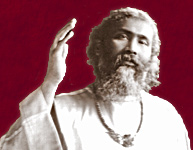

Daya and ShardaThe Love Story of Inayat Khan and Ora Ray BakerOra and the Children After Inayat’s Death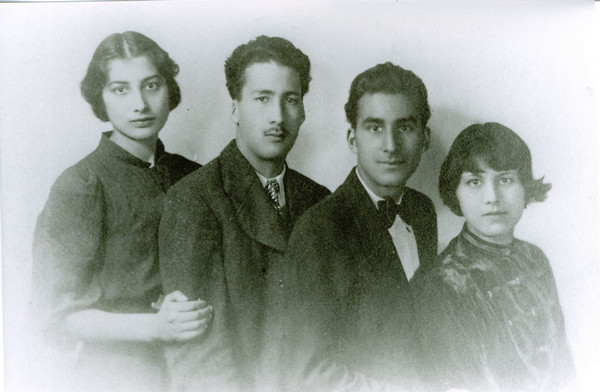 Every year on the day of Inayat’s death, a commemorative event was held in the Oriental Room of Fazal Manzai. Ora decorated a picture of Inayat with a wreath of yellow roses, something that had taken her "hours to make" since "roses have their thorns," according to Claire. Once the procession began for Visalat Day, as it was known, Ora’s children would greet the arriving mureeds, who would walk into the perfumed room barefoot, carrying their own bouquets that they used to give their respects. Ora’s grief would especially be felt on this day. Claire recalled that Ora would usually be too sad to come downstairs and would keep on crying. Aside from Visalat Day, Claire remarked that "our mother spent many years in a state of depression, often keeping to her bed" and that "sometimes she would hardly eat for days." Her malnutrition became so severe from time to time that Claire and her siblings, led by Noor, would threaten Ora with not eating themselves. Nevertheless, Ora kept on working through it all, making clothes for her family, including a lovely white silk dress for Claire, and washing them at home, since she could not afford to take them to a laundry. At first, after Inayat’s death, Fazal Mai provided economic support, but after she died in 1939, there were questions about where money would come from. According to Claire, Ora was proud and wanted some financial independence. Even so, she asked for economic support from her uncle, George W. Baker, a wealthy lawyer and rancher who lived in New Mexico and was happy to help them. He continued giving them financial support until World War Two. Additionally, Kismet Dorothea Stam would later provide tuition fees for the children’s musical education. It is difficult to gauge the state of the family’s finances, but what is known for certain is that it was unstable. Troubles arose in the Sufi Movement after Inayat’s passing. Conflict emerged over who would hold leadership positions in the Movement, with Ora being alone to fight to maintain the movement, and some of the mureeds were unkind to her. Claire later found out that, before his death, the Sufi Movement had successfully pressured Inayat to give up the rights to the books he had written--books that the Sufi Movement now owned as a result. Vilayat, the eldest son, at age fifteen began vigorously studying everything related to the Sufi Movement. Before Inayat left for India, he appointed Vilayat, then age ten, to be head of the Confraternity of the Message. Vilayat would eventually become Inayat’s successor in terms of the spiritual movement, but there were clashes in his teenage years, including one instance where his uncle Musharraf tied him to a tree and beat him with a stick over a disagreement about the Sufi message, until the neighbors intervened.187 In addition to Vilayat’s important role as the eventual Murshid of the movement, he also served as a pilot for the British army during World War Two and participated in D-Day.188 Noor, the eldest child and sister who, according to Claire, set an "unattainable example,"189 would become a hero for Britain during World War Two. The author of both songs and books, including an adaptation of Jataka Tales, and having a degree in Child Psychology from the University of Paris190, Noor became one of the most wanted spies on Nazi Germany’s list, hiding her secret work from her family in her letters to them after she went to France as an agent of the Special Operations Executive. Interestingly, her secret identity was "Nora Baker," similar to her mother’s name Ora Ray Baker. Eventually she was betrayed, caught, tortured, and executed by the Gestapo at the Dachau camp.191 Claire and Vilayat tried to keep the news of Noor’s demise from Ora.192 Hidayat, who in his childhood had formed a strong bond with Claire, while Vilayat had teamed up with Noor, became a musical composer and conductor. He studied at the Ecole Normal de Musique in Paris starting in 1932 and went on to work at the Lycee Musical de Dieulefit as a professor of music. After that he joined an orchestra as a violinist in Haarlem, Holland.193 He married a Dutch woman named Leni (later called Iman).194 Claire, along with Noor, started by working as a Red Cross nurse during World War Two.195 After Ora’s death in 1949, Claire moved to the United States, where she had a son196, David Harper197 who wrote We Rubies Four. Soon after David’s second birthday, Claire and Vilayat decided to visit their uncle Pierre, Ora’s half-brother who had objected so violently to Ora’s relationship with Inayat many years ago. Pierre’s sentiments had apparently not changed, as he received them coldly, as compared to his wife, Blanche de Vries, who was kinder to her niece and nephew. Claire described the meeting with Pierre: "Sitting at his desk, he opened a drawer and showed us a gun. ‘If I had found him, I was going to kill your father with this gun!’ he bragged.’"198 Decades had passed since Ora had revealed to Pierre that she was in love with Inayat. There was no evidence that Ora had ever seen Pierre again after running away to Europe. Despite the passage of time, Pierre still refused to accept Ora and Inayat’s relationship. He also did not at all seem to feel regretful about the way he had behaved or the racism he had displayed, showing how long white men’s imagined defense of and control over their women from racial "others" can last. As historian Nayan Shah notes," Their honor [white men] in defending white women…became a communal and racial property that trumped…physical violence."199 Pierre’s patriarchal claim to Ora was more important than Ora’s autonomy and Inayat’s life, even well into Pierre’s later years, even when meeting the children of Ora and Inayat. Ora Ray Baker passed away on May 2, 1949, in Paris, France.200 Claire, who was greatly affected by her mother’s death, wrote, "Ora Ray, Pirani Ameena Begum Inayat Khan, left this planet long before her time. Though her face was thin, she still wore the glow of youth. Perhaps Mother could not visualize herself under the ground in the neighborhood. She wished to be with her Thea in the skies and the stars."201 Inayat and Ora had been married for fourteen years and they had four children. Their love story had initially been a forbidden romance that resulted in elopement to Europe, where they married and worked incredibly hard to spread the Sufi Message. Despite the harsh realities that marked the trajectory of their lives, the initial love that drew them together appeared to last until both of their deaths. Examining Inayat’s and Ora’s relationship reveals how their upper-class status and the Orientalist perceptions of Inayat made their meeting possible; it also makes clear the obstacle of violent racism they faced in the United States, as well as the crucial labor Ora and other women performed to maintain both the Khan household and the Sufi Movement in the West. |
