

Daya and ShardaThe Love Story of Inayat Khan and Ora Ray BakerOra’s Escape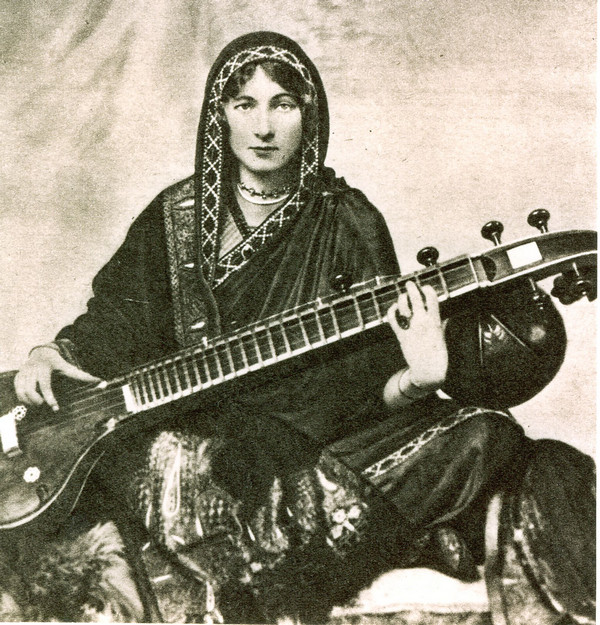 A period of silence from Inayat ensued, perhaps because Pierre interfered with Inayat’s letters, causing Ora’s nights to be "starved of sleep", according to her daughter Claire. Claire said that "The echo of love’s call could be heard in the dark blue sky. The silence and the separation made her ill."43 But illness did not ever seem to be a significant enough obstacle to stop Ora when she had made up her mind about something, and so she wrote another letter to her Daya, raising the issue of his silence.44 Additionally, Pierre was able to gain information about Inayat, as Ora recounted in her 43rd letter to Inayat, saying, "…my brother even knew your address at the last place where you were in N.Y. he even knew of the short illness you had there for a few days, how he knew, I do not know, some one certainly told him."45 Ora’s mention of "someone" giving Pierre information, both in this and previous letters, indicates that Pierre was not alone in his mission to prevent Ora and Inayat from being together. Ora also mentioned to Inayat that "Baba could easily locate you" when discussing where in Europe she should stay after her escape. Ora may have been referring to her father by the word "Baba," a common term for father amongst Indian and Muslim cultures. It is unclear who was assisting Pierre. Ora might have been referring to her family, as suggested by her usage of the phrase "my folks" in a letter to Inayat, but one can only speculate on the identity of Pierre’s supporters. Ora discussed with Inayat her thoughts about what story could be relayed to her family after she escaped. She went over several possibilities, saying "…it will not do for one to write my folks that I have committed suicide for they may receive the letter before I could board the steamer so I think it best to just disappear taking my grip with a few things in it as is natural in traveling and leaving my trunk at the station. They will locate my trunk and may perhaps think I have been killed by some man or that I may have been stolen in some way or other and for some purpose as you oft read of some crimes."46 Whether Ora was using humor to make light of the situation or whether she truly did not care if her family thought she might have been murdered or committed suicide is not clear. If the latter, her thinking may have possibly been encouraged by the difficult, abusive time Pierre and possibly other family members had put her through after her relationship with Inayat had been found out. Ora’s thoughtful planning reveals her cleverness, determination, and "youthful zest."47 Characteristic of their relationship, passion also infused the letters Ora wrote to Inayat, as in a love poem she sent in her 54th letter: Far away is my Daya, Ora did not have to die a thousand deaths to join her Daya, but she did have to be very discreet on the night of February 28th, 1913, when she boarded the ship that would take her from Philadelphia, Pennsylvania to Antwerp, Belgium. As Ora mentioned to Inayat, she had purchased the ticket for the passage in New York. The night Ora made her escape had been a typical outing for a wealthy white American woman, a "country club theater evening," as Claire called it. Ora wore a beautiful dress along with a cape that hid a bag. Whilst on her way to the docks and the ship that would take her to Europe, Ora changed from her gown into a suit, tied up her hair, and hid it under a hat so that it was no longer visible. She carried only a small case that held a silver toilette set.49 What happened to the gown she had been wearing or whether she had enough changes of clothes to last the journey is not included in Claire’s account. Ora successfully transformed herself and slipped away to the ship that would take Sharda50 to her Daya. Once on board, she secluded herself in her private cabin, staying there for the entire journey and having an attendant bring her meals to her room.51 Not a strand of hair was out of place when she had boarded, and not a single clue given that might cause her to be noticed or suspected by anyone. Ora carefully carried out her plan, showing her determination to rejoin the one she considered her soulmate. Ora conveyed the need for carefulness to Inayat as well. She implored him to be on guard when she departed from America, in case Pierre had hired detectives to find her, saying, "Dear heart, I do not want to endanger your life…you must always be well guarded from the day I leave here, and when I arrive on the other side, you must not see me…" The harsh reality of Pierre’s wrath haunted the lovers in the beginning stages of their relationship, but Ora, on the ship alone, dreamt hopefully of a new life. Claire recounted, "As the ship slowly moved on into the distance, she opened her porthole; darkness fell, lighting her view with a show of stars--even the full moon appeared bright and happy. Above the ship, like seagulls, cherubs followed the voyage, holding hands and announcing the reunion of two hearts."52 In Antwerp, Belgium, Sharda reunited with her Daya. To ensure safety, they had avoided England’s ports when the ship reached Europe. From Belgium, the couple quietly made their way to London, where they married on the 20th of March, 1913. Even though Ora registered herself at marriage as "Ora Ray Baker, otherwise Ora Bernard", including both the names her father and Pierre gave her, she became known by the name Ameena Begum from then on, with Ameena being her Sufi name, and Begum, referring to "lady", being her title. Not long after the marriage was officially registered, Ora and Inayat enjoyed a traditional Indian Muslim wedding that had been organized by Inayat’s cousin, Mohammed Ali.53 Afterwards, Ora and Inayat spent the first few months of their marriage alternating between London and Paris. In contrast to the United States, England did not seem to have laws against interracial marriages. In fact, it was already a well-established trend since the 1800s for Indian men of various class backgrounds to marry white women while in England, with a few Indian men doing so as early as the seventeenth century. One educated Bengali Indian man, Rajandrachandra Chandra, even married a white woman from an aristocratic family in the late 1850s. Men from working-class backgrounds, such as lascar men, often married women of a similar class status.54 However, just because it was allowed did not mean it was always socially accepted.55 The danger of Pierre killing Inayat and taking Ora back to America shadowed the start of their marriage and life together in Europe. While they were in Paris, the police knocked on the couple’s door, looking for a runaway American woman. Luckily, the police could not take Ora, as she was a legal adult at her current age of 25 and was officially married to Inayat. After this incident, Pierre’s and Ora’s family’s active stalking of Ora and Inayat seemed to end. Although Pierre’s hatred for Inayat and violent disapproval of Ora’s marriage lasted well past Inayat’s death, no other incidents masterminded by Pierre plagued Ora and Inayat during their marriage.56 |
